_edited.jpg)
What to Look for in a Secure Truck Parking Facility
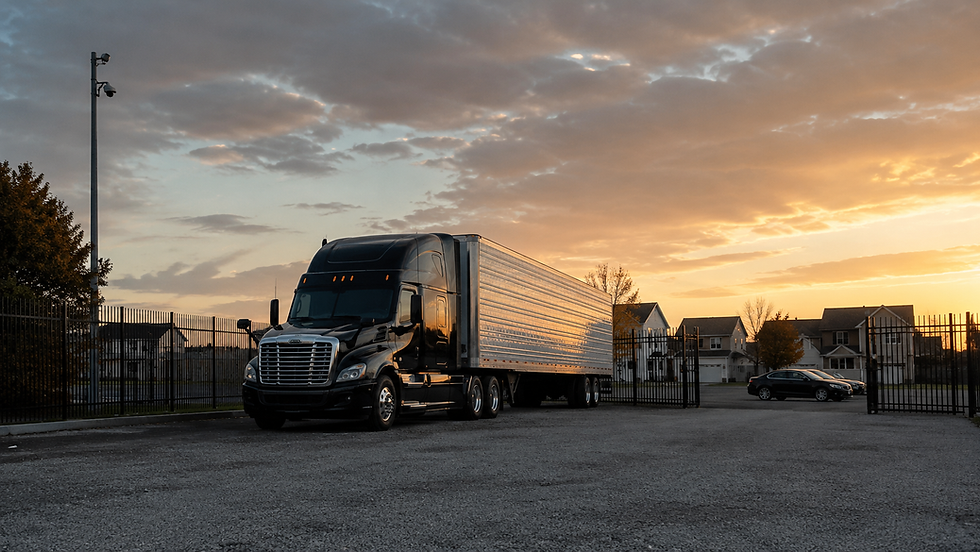
A secure truck parking facility is a designated, access-controlled commercial lot that provides physical perimeter protection, 24-hour surveillance, verified entry systems, trained on-site personnel, and certified safety infrastructure to protect commercial trucks, drivers, and cargo from theft, vandalism, and unauthorized access.
According to CargoNet, cargo theft costs the U.S. trucking industry approximately $223 million per year in direct losses. Full truckload theft represents the highest-value incident category, with an average loss of $214,104 per event. Truck drivers and fleet managers evaluate parking facilities across 6 primary security dimensions: physical infrastructure, surveillance, access control, lighting, staffing, and compliance certifications. Each dimension addresses a specific, documentable vulnerability in truck and cargo protection.
KP Truck Parking designs its facilities around all 6 security dimensions. This guide defines each dimension with measurable standards and provides 10 direct verification questions to use when evaluating any facility.
What Is a Secure Truck Parking Facility?
A secure truck parking facility is a commercial lot specifically designed for heavy vehicles. It provides perimeter fencing, surveillance cameras, electronic access control, and on-site security personnel to protect trucks and cargo. Operations run 24 hours per day, 7 days per week.
A secure truck parking facility differs from a standard rest area, highway pull-off, or unmonitored commercial lot. Standard rest areas provide zero physical security infrastructure. A secure facility provides verifiable, layered protection for the truck, the driver, and the cargo simultaneously.
The 6 core components of a secure truck parking facility are:
Perimeter security infrastructure — physical barriers that define and enforce the facility boundary
Surveillance systems — cameras and monitoring equipment that record activity at all access points and parking zones continuously
Access control systems — electronic gates, key cards, PIN terminals, or biometric readers that restrict entry to authorized vehicles only
On-site security personnel — trained guards who patrol, monitor, and respond to security incidents
Lighting systems — illumination infrastructure that meets commercial security standards across every parking zone
Compliance certifications — documented adherence to standards from the TSA, FMCSA, and applicable state regulatory bodies
A facility that satisfies all 6 components provides protection against the 3 primary risk categories in commercial vehicle parking: cargo theft, vehicle damage, and driver safety incidents. Physical security infrastructure is the foundational component that all other layers reinforce.
What Physical Security Features Should a Truck Parking Facility Have?
A secure truck parking facility requires a minimum 6-foot perimeter fence with anti-climb features, electronically controlled entry and exit gates, anti-ram bollards at vehicle entry points, and a gapless facility boundary. Physical infrastructure is the primary deterrence layer for cargo and vehicle protection.
Physical security infrastructure is the first and most visible protection layer at any truck parking facility. According to a 2022 loss prevention study by the National Cargo Security Council, opportunistic theft drops by 73% when visible physical deterrence is present. Physical infrastructure creates a defined perimeter that separates the secured area from public access zones.
Perimeter Fencing Standards
A complete perimeter fence meets 4 specifications:
Height — a minimum of 6 feet, with 8-foot fencing required for facilities storing high-value cargo
Material — chain-link with anti-climb mesh, welded wire panel, or steel palisade construction with barbed wire toppers or rotating anti-climb devices
Integrity — zero gaps, holes, or sections permitting pedestrian or vehicle access outside designated gates
Visibility — fence construction allows surveillance cameras and security personnel to see through to the perimeter without obstruction
Gate and Entry Point Requirements
A secure facility operates a minimum of 2 gate configurations: one primary entry and exit gate and one secondary emergency access gate. Both gates use mechanical or electronic locking systems. Manual padlocked gates present a lower security rating than electronically controlled barrier arms or sliding gates with remote operation capability.
Anti-ram bollards protect entry points from forced vehicle entry. A ram-raid is a vehicle-based forced entry method in which an unauthorized vehicle drives through a gate or barrier at speed. Anti-ram bollards rated to PAS 68 or ASTM F2656 standards stop vehicles weighing up to 7.5 tons traveling at 40 mph.
Physical Intrusion Barriers
A complete physical security perimeter includes 5 barrier types:
Anti-climb fence toppers — deterrent devices mounted on fence tops to prevent scaling, including barbed wire, razor coil, or rotating pipe systems
Ground anchors — fixed points within parking zones that allow drivers to secure trailers with additional locks during extended stays
Tire deflation barriers — deployed at exit points only, preventing unauthorized vehicles from leaving without proper gate authorization
Concrete Jersey barriers — used at facility perimeters in high-risk locations to prevent vehicle ramming of the fence line
Secured equipment storage — locked areas for driver personal equipment, high-value accessories, and spare parts
Physical infrastructure is the first evaluation criterion for any truck driver or fleet manager assessing a facility. A facility that fails this criterion presents vulnerabilities that surveillance and staffing alone cannot compensate for. Surveillance systems form the second security layer that operates continuously across the physical perimeter.
What Surveillance and Monitoring Systems Are Essential for Truck Parking?
A secure truck parking facility operates a minimum of 1 surveillance camera per 4 parking spaces. Cameras cover all entry gates, the full perimeter fence line, and every parking row. The system retains footage for a minimum of 30 days.
Surveillance is the second security layer at a truck parking facility. It provides real-time monitoring, incident documentation, and post-event evidence for law enforcement investigations. A facility without adequate surveillance coverage cannot produce usable evidence in a cargo theft claim.
Camera Coverage Requirements
A complete surveillance system covers 6 zones:
Entry and exit gates — license plate recognition cameras positioned to capture every vehicle registration plate at all access points
Perimeter fence line — cameras covering 100% of the fence perimeter with no blind spots between adjacent fields of view
Parking rows — overhead or pole-mounted cameras covering every parking space with no unmonitored gaps
Driver amenity areas — exterior cameras covering restroom building entrances, fuel stations, and common areas
Security booth and office areas — cameras covering guard stations, management offices, and key storage locations
Low-light zones — infrared-enabled cameras covering all areas beyond the primary lighting range
Camera Specifications
A minimum camera specification for a secure truck parking facility meets 4 technical standards:
Resolution — 4K (3840 x 2160 pixels) preferred; 1080p (1920 x 1080 pixels) is the minimum standard for usable license plate capture
Frame rate — 25 frames per second minimum to capture clear movement footage for incident investigation
Night vision — infrared range of 30 meters minimum for full coverage during hours of darkness
Weather rating — IP66 or IP67 certification for waterproof and dust-proof performance in all weather conditions
Monitoring Center Requirements
A secure truck parking facility operates a dedicated monitoring center with 3 functional components:
Live feed access — all cameras feed to a central display visible to on-site security personnel during all staffed hours
Remote monitoring integration — camera systems connect to a third-party monitoring service that responds to motion-triggered alerts during unstaffed periods
Footage retention — a minimum of 30 days stored in an on-site network video recorder (NVR) or a cloud-based video management system (VMS)
License Plate Recognition Systems
A license plate recognition (LPR) camera is a surveillance component that reads and logs vehicle registration plates automatically at entry and exit. LPR data creates a timestamped vehicle movement log, matching each entry record against the facility's authorized vehicle database. A facility without LPR cameras cannot verify whether a specific truck was present during a specific time window. Access control systems use this LPR log as the primary vehicle identification record for every security event on-site.
How Does Access Control Protect Trucks and Cargo at a Parking Facility?
Access control at a truck parking facility uses electronic gate barriers, key card readers, PIN entry terminals, or biometric verification to restrict entry to authorized vehicles. The system generates a timestamped entry and exit log for every vehicle.
Access control is the third security layer at a truck parking facility. It prevents unauthorized vehicles and individuals from entering the secured perimeter. The timestamped log it generates is the primary evidentiary record in cargo theft and vehicle damage investigations.
Access Control System Types
A secure truck parking facility implements one or more of 4 recognized access control technologies:
Key card and proximity card systems — each authorized user receives a physical RFID card that triggers gate opening when presented to a reader; lost or stolen cards are deactivated remotely within 15 minutes of reporting
PIN code entry terminals — numeric codes assigned per driver or per fleet account; codes rotate on a 7-day or 30-day cycle to prevent code sharing
Biometric readers — fingerprint or retinal scan systems that verify individual driver identity before granting access; biometric systems represent the highest security rating among access control types
Mobile application-based access — smartphone-based gate control using geofencing and digital credentials; used by facilities operating app-based reservation platforms
Entry Logging and Audit Trails
Every access control event generates a timestamped log entry. A complete access log records 4 data points per event:
Vehicle license plate number
Driver credential identifier: card ID, PIN code, or biometric ID
Date and time of entry
Date and time of exit
This log is the primary document presented to law enforcement when a cargo theft or vehicle damage incident is reported. A facility unable to produce this log within 24 hours of a request provides significantly weaker accountability than a fully logged system.
Temporary and Guest Access Protocols
A secure facility operates a formalized temporary access protocol for vehicles not pre-registered in the system. This protocol records 3 minimum data points: identity verification at the security booth, manual license plate logging, and issuance of a time-limited access credential. A facility without a temporary access protocol creates an unlogged entry gap. Lighting systems close the next major vulnerability by eliminating concealment zones across every parking zone.
What Lighting Standards Are Required for Secure Truck Parking?
A secure truck parking facility maintains a minimum of 2 foot-candles across all parking areas and 5 foot-candles at entry points and gates. Lighting operates continuously during darkness and connects to a backup power source activating within 10 seconds of a primary power failure.
Lighting is the fourth security layer at a truck parking facility. Adequate illumination enables surveillance cameras to capture usable footage at night, eliminates concealment zones used by theft operatives, and ensures driver safety during nighttime arrivals and departures.
Illumination Standards by Zone
According to the Illuminating Engineering Society RP-20 standard for Parking Facilities, 4 illumination minimums apply to commercial parking:
General parking areas — 2 foot-candles (fc) average maintained illuminance minimum
Entry and exit lanes — 5 fc average maintained illuminance minimum
Pedestrian walkways — 3 fc average maintained illuminance minimum
Security booths and guard stations — 10 fc at guard face level minimum
LED Lighting Technology Requirements
A secure truck parking facility uses LED lighting technology across all security zones. LED fixtures provide 4 specific security advantages over legacy metal halide or high-pressure sodium systems:
Instant-on capability — LEDs reach full brightness in under 1 second, compared to 3 to 5 minutes for legacy systems, enabling immediate full illumination after a motion trigger
Uniformity — LED arrays produce consistent light distribution with fewer dark zones between fixtures, eliminating gaps that older point-source lamps create
Camera compatibility — LED color temperature of 4000K to 5000K produces the optimal contrast range for IP security camera imaging
Energy efficiency — LED systems consume 50% to 70% less energy than equivalent metal halide systems, enabling facility-wide full lighting without excessive operational cost
Backup Power Requirements
A secure truck parking facility connects its lighting and surveillance systems to one of 3 backup power configurations:
Generator backup — a diesel or natural gas generator with an automatic transfer switch that activates within 10 seconds of primary power failure
Battery backup — uninterruptible power supply (UPS) units providing a minimum of 4 hours of continuous lighting operation per charge cycle
Solar hybrid systems — solar panels combined with battery storage that maintain lighting operation during grid outages of any duration
According to a 2021 Sensitech cargo security report, power outages precede 12% of cargo theft incidents, confirming that power disruption is an active
method used in cargo theft operations. A facility without backup power lighting presents a documented security gap. Certifications validate that a facility's infrastructure meets the standards these 4 security layers are designed to fulfill.
What Certifications and Compliance Standards Should a Truck Parking Facility Meet?
A compliant secure truck parking facility meets standards from 3 regulatory bodies: the TSA through C-TPAT, the FMCSA through 49 CFR compliance, and applicable state commercial parking regulations. C-TPAT certification from U.S. Customs and Border Protection is the highest industry security validation.
Certifications verify that a facility meets documented, third-party-audited security standards. A certified facility has passed an external review against defined criteria. Certification documents carry active issuance dates and are available for review on request.
C-TPAT Certification
The Customs-Trade Partnership Against Terrorism (C-TPAT) is a voluntary supply chain security program administered by U.S. Customs and Border Protection (CBP). C-TPAT-certified facilities meet 6 core security criteria:
Physical access controls restricting facility entry to authorized personnel and vehicles
Personnel security procedures including background checks for all security staff and management
Procedural security protocols covering cargo handling, seal verification, and incident reporting
Physical security infrastructure meeting defined perimeter, gate, and lighting standards
Information technology security for access control systems and digital records
Annual training and threat awareness programs for all facility personnel
A C-TPAT-certified truck parking facility provides supply chain partners with CBP-validated security assurance. Fleet managers transporting high-value loads, bonded cargo, or imported goods under customs control prioritize C-TPAT-certified facilities over non-certified alternatives.
FMCSA Compliance
The Federal Motor Carrier Safety Administration (FMCSA) governs commercial vehicle operations in the United States under Title 49 of the Code of Federal Regulations. FMCSA compliance requirements relevant to truck parking facilities cover 3 areas:
Hours of Service documentation support — a compliant facility provides Wi-Fi access and ELD connectivity supporting driver log compliance under 49 CFR Part 395
HAZMAT parking zones — facilities accepting hazardous materials loads maintain segregated parking areas compliant with 49 CFR Part 177 and PHMSA Hazardous Materials Regulations
Driver facility access — compliant facilities provide restroom access, potable water, and rest areas meeting minimum federal standards
State-Level Commercial Parking Regulations
12 U.S. states have enacted specific commercial truck parking security regulations as of 2024. California (AB 5 compliance zones), Texas (TxDOT Freight Advisory Committee standards), and Florida (FDOT freight facility guidelines) represent 3 states with the most detailed state-specific requirements. A facility in these states provides compliance documentation upon request. On-site security staffing enforces these certified standards in real time.
How Do Staffing and Security Personnel Affect Truck Parking Safety?
A secure truck parking facility employs a minimum of 1 trained security officer per 50 parking spaces per shift, 24 hours per day. Security personnel hold valid state licenses, complete annual cargo theft training, and follow written incident response protocols covering 5 incident categories.
Staffing is the fifth security layer at a truck parking facility. According to the International Foundation for Protection Officers (IFPO), on-site security personnel provide active deterrence, incident response capability, and driver assistance that automated systems cannot replicate.
Staffing Ratio Standards
IFPO recommends 3 staffing tiers for commercial vehicle parking facilities:
Facilities with fewer than 50 spaces — 1 security officer per shift, minimum
Facilities with 50 to 150 spaces — 2 security officers per shift, with 1 assigned to active patrol and 1 at the guard station
Facilities with more than 150 spaces — 1 security officer per 50 spaces, with scheduled patrol rotations every 60 minutes maximum
According to FBI Uniform Crime Reporting data, commercial cargo theft occurs disproportionately between 10:00 PM and 6:00 AM. A facility operating daytime-only security staffing presents its highest vulnerability during this 8-hour window. Full 24-hour staffing is the standard a facility must meet to qualify as genuinely secure.
Security Personnel Qualifications
Security personnel at a compliant truck parking facility hold 5 documented qualifications:
State security officer license — a valid license from the state's regulatory body, such as the Bureau of Security and Investigative Services (BSIS) in California or the Department of Public Safety (DPS) in Texas
Cargo theft awareness training — completion of a recognized program such as the National Insurance Crime Bureau (NICB) cargo theft prevention curriculum
Emergency response certification — CPR and AED certification with basic first aid training, renewed every 2 years
Access control system operation — documented training on the facility's specific access control platform, including credential issuance, deactivation, and audit log retrieval
Incident reporting competency — demonstrated ability to complete accurate, timestamped incident reports meeting the evidentiary standards required for insurance claims and law enforcement investigation
Incident Response Protocols
A secure facility operates written incident response protocols covering 5 incident categories:
Unauthorized entry attempts at any gate or perimeter point
Cargo theft or attempted theft of any load or vehicle component
Driver safety incidents including altercations, medical emergencies, or threats
Vehicle damage events including collisions, vandalism, or equipment failure
Hazardous materials incidents including spills, leaks, or seal failure on HAZMAT loads
Facilities without written incident response protocols rely on ad-hoc staff decisions during incidents, increasing response time and reducing evidence preservation quality. Comprehensive driver amenities extend the effectiveness of staffing by reducing driver movement outside the secured perimeter during mandated rest periods.
What Amenities and Operational Services Should a Secure Truck Parking Facility Provide?
A fully operational secure truck parking facility provides 8 driver amenities: restrooms, showers, food service, Wi-Fi, electrical hookups, fuel service, laundry, and a driver lounge. These amenities support Hours of Service compliance without requiring drivers to leave the secured perimeter.
Amenities and operational services are distinct from security infrastructure but directly affect security outcomes. A facility that provides comprehensive amenities reduces driver movement outside the secured zone, decreasing exposure to theft, accident, and safety risks. KP Truck Parking amenities are designed to support complete on-site operations during every mandated rest period.
Core Amenity Requirements
A secure truck parking facility provides 8 driver amenities:
Restrooms — clean, accessible facilities open 24 hours per day with documented cleaning schedules
Showers — private stalls with hot water available 24 hours per day at a minimum ratio of 1 shower per 15 parking spaces
Food service — an on-site restaurant, cafeteria, or 24-hour vending service providing hot food options without requiring drivers to leave the facility
Wi-Fi access — secured wireless internet throughout the driver amenity area, supporting ELD connectivity and dispatch communication
Electrical hookups (shore power) — 120V or 240V connections at individual parking spaces enabling engine-off operations that reduce fuel consumption and noise
Fuel service — on-site diesel and DEF (Diesel Exhaust Fluid) dispensing, or a documented fueling arrangement with a supplier within 0.25 miles of the facility
Laundry facilities — coin-operated or app-payment washer and dryer units accessible during amenity area hours
Driver lounge — a secured rest area with seating, television, climate control, and device charging stations
Reservation and Booking Systems
A secure facility operates a reservation system allowing drivers and fleet managers to book spaces in advance. A functional reservation system provides 3 specific security benefits:
Space guarantee — a confirmed reservation prevents drivers from being turned away and seeking unsecured alternatives at the end of a driving shift
Vehicle pre-registration — reservation systems capture vehicle plate data before arrival, enabling LPR pre-verification and strengthening the facility's entry log
Capacity management — reservation data prevents overcrowding, which degrades camera coverage angles and reduces patrol route efficiency
Book a parking space at KP Truck Parking in advance to confirm availability and pre-register your vehicle before arrival.
Facility Maintenance Standards
A secure truck parking facility maintains its physical infrastructure with documented inspection schedules. Broken fencing, non-functional cameras, and failed lighting fixtures create security gaps. A compliant facility maintains a weekly inspection log covering all security infrastructure components, with a documented maximum repair response time of 24 hours for critical security failures. Location and layout determine whether a facility's infrastructure can be monitored and maintained effectively at scale.
How Does Location and Layout Impact Truck Parking Security?
A secure truck parking facility is located within 0.5 miles of a major highway interchange on a site with a single controlled entrance. The layout physically separates truck and passenger vehicle areas and provides unobstructed camera sightlines across all parking spaces.
Location and layout are structural security factors that cannot be retrofitted after construction. Evaluating these factors before selecting a facility identifies fundamental limitations that technology and staffing cannot overcome.
Location Criteria
A secure truck parking facility meets 4 location criteria:
Highway proximity — within 0.5 miles of a major interstate interchange, reducing time trucks spend on local roads where cargo theft risk is statistically higher
Site visibility — the facility's exterior is visible from a main road or highway, reducing the isolated-site vulnerability that organized cargo theft operations deliberately seek
Emergency services proximity — within 10 miles of a law enforcement station, or within a jurisdiction with documented average police response times under 10 minutes
Zoning compliance — located in a commercially or industrially zoned area permitting 24-hour commercial vehicle operations without residential noise or access restrictions
Layout Design for Security
A security-optimized facility layout incorporates 6 design principles:
Single controlled entry point — one primary entrance through which all vehicles pass, eliminating perimeter gaps that secondary access points create
Truck and passenger vehicle separation — designated truck parking zones physically separated from passenger car areas using barriers or marked perimeter lines
Unobstructed camera sightlines — parking rows oriented so camera fields of view cover all spaces without structural columns or trailers blocking sight lines
Guard station placement — the security booth positioned at the primary entry point with a direct visual line to the entry lane and the main parking area
Emergency vehicle access — internal circulation roads with a minimum lane width of 20 feet, maintained clear of equipment at all times
Paved, drained surfaces — all-weather paved surfaces with adequate drainage remaining accessible in rain, ice, or snow conditions
Functional Zone Configuration
A large-scale secure truck parking facility divides its lot into 4 functional zones:
Active parking zone — spaces for trucks with active, loaded trailers under full surveillance coverage
Drop yard zone — spaces for unattended trailer drops with additional monitoring and seal verification protocols
HAZMAT isolation zone — a segregated area for hazardous materials loads, separated from the active zone by a minimum of 50 feet, compliant with 49 CFR Part 177; KP Truck Parking meets all PHMSA separation and signage requirements
Inspection and repair zone — a dedicated area for pre-trip inspections and minor repairs that does not obstruct active parking lanes or camera sightlines
Technology systems extend the security that physical infrastructure and spatial design establish.
What Technology Systems Enhance Truck Parking Facility Security?
A technologically advanced secure truck parking facility integrates 6 systems: a cloud-based video management system, license plate recognition, a yard management system, GPS trailer tracking, IoT perimeter sensors, and a centralized security operations platform consolidating all system alerts.
Technology systems extend the effectiveness of physical security infrastructure and staffing. Each system addresses a specific vulnerability that physical measures or personnel alone cannot adequately cover at scale.
Video Management System
A Video Management System (VMS) is software that centralizes control of all surveillance cameras, manages footage storage, and enables remote viewing by authorized users. A cloud-based VMS provides 3 advantages over a local-only system:
Remote access — fleet managers, facility operators, and law enforcement access live and recorded footage from any internet-connected device without requiring physical presence at the facility
Off-site storage redundancy — footage stored in the cloud remains accessible when on-site NVR hardware is physically damaged or stolen during an incident
AI-powered anomaly detection — VMS platforms with integrated AI analytics detect and alert on activity patterns such as loitering near trailers, perimeter approach, or trailer movement during non-operational hours
Yard Management System
A Yard Management System (YMS) is software that tracks the location, status, and movement of trailers and trucks within a facility. A YMS provides 4 security-relevant functions:
Real-time trailer location — GPS or RFID-based tracking showing the exact location of every trailer in the yard at any time
Check-in and check-out automation — timestamped records generated automatically for every trailer entering or exiting the yard
Cargo seal verification — integration with seal tracking systems that flags unsealed or physically tampered loads immediately upon detection
Unauthorized movement alerts — automated notifications sent to the security operations platform when a trailer moves without an associated authorized check-out event
IoT Perimeter Sensor Networks
An Internet of Things (IoT) perimeter sensor network deploys physical sensors along the facility fence line to detect intrusion attempts. Sensor types include vibration sensors that detect fence cutting or climbing, passive infrared motion detectors, and ground-based seismic detectors. A complete IoT perimeter sensor network covers 100% of the fence line and generates alerts within 3 seconds of detection.
Cargo Tracking Integration
A secure parking facility integrates with fleet-operated cargo tracking systems such as Samsara, Verizon Connect, or Motive. Integration allows fleet managers to receive alerts when trailers move while parked. Any unauthorized movement triggers simultaneous notifications to the fleet manager's dispatch system and the facility's security operations platform, enabling coordinated response. Cargo and load security protocols are the operational complement to these technology systems.
How Should Cargo and Load Security Be Managed at a Truck Parking Facility?
A secure truck parking facility implements 5 cargo security protocols: king pin lock verification at check-in, trailer door seal inspection, HAZMAT load segregation, a designated high-value cargo zone with enhanced physical controls, and mandatory cargo seal number logging.
Cargo security management is the operational layer that protects the load itself, distinct from protecting the vehicle or the facility perimeter. These protocols address the specific methods used in organized cargo theft operations.
King Pin and Trailer Lock Requirements
A king pin lock is a physical security device that fits over a trailer's king pin coupler, preventing unauthorized attachment of a tractor unit to the trailer. A secure truck parking facility requires king pin lock installation for all unattended trailers carrying active cargo.
According to the National Cargo Security Council, 4 additional trailer security devices are recognized in cargo theft prevention programs:
Glad hand locks — devices that lock the trailer's air supply coupling, preventing brake release and trailer movement without the locking key
Landing gear locks — devices that lock the trailer's landing gear legs, preventing lowering and detachment from a tractor
Door bar locks — high-security padlocks or puck locks installed on trailer door hasp assemblies to prevent rear door opening
Electronic cargo seals — battery-powered seals that transmit tamper alerts via cellular or satellite networks to the fleet manager's system in real time
High-Value Cargo Zones
A high-value cargo (HVC) zone is a designated area within the parking facility with elevated security measures beyond the standard perimeter. HVC zones are required for shipments with declared cargo values exceeding $50,000. A compliant HVC zone includes 4 enhanced features:
Secondary perimeter fencing creating an enclosed zone within the main facility perimeter
Dedicated surveillance cameras operating above the facility's minimum resolution and frame rate specifications
Restricted access requiring a separate credential beyond the standard facility access credential
Security guard patrol intervals of 30 minutes or less throughout the designated zone
Fleet truck parking at KP Truck Parking includes access to a designated HVC zone for fleet operators transporting high-value loads.
Cargo Seal Logging Protocols
A complete cargo seal logging protocol records 5 data points at check-in for every trailer carrying an active load:
Trailer license plate number and VIN
Cargo seal number as printed on the physical seal applied to the trailer door
Driver full name and CDL number
Scheduled departure date and time
Cargo category: general freight, high-value, temperature-controlled, or HAZMAT
A mismatch between the logged seal number and the physical seal at departure triggers immediate incident response, isolating the trailer until verification completes. These operational protocols are the final layer to confirm when directly evaluating a facility.
What Questions Should You Ask Before Choosing a Secure Truck Parking Facility?
Before selecting a truck parking facility, drivers and fleet managers ask 10 direct verification questions covering certifications, surveillance retention, staffing schedules, access control systems, incident history, amenity availability, reservation systems, cargo protocols, insurance coverage, and backup power.
Selecting a secure truck parking facility requires direct verification beyond reviewing a facility's website or marketing materials. The 10 questions below produce specific, documentable answers that allow direct comparison between facilities.
10 Direct Verification Questions
1. Does the facility hold a current C-TPAT certification, and can you provide the CBP-issued certificate?
A C-TPAT-certified facility provides a certificate issued by U.S. Customs and Border Protection with an active certification date. An expired certificate or inability to produce documentation indicates a lapsed or non-existent certification.
2. How many surveillance cameras does the facility operate, and what is the minimum camera resolution?
A minimum of 1 camera per 4 spaces at 1080p resolution is the baseline standard. A facility with fewer cameras relative to its space count, or cameras below 1080p, presents specific surveillance gaps that staffing alone cannot address.
3. For how many days does the facility retain surveillance footage?
A minimum of 30 days of retention is the industry standard. Cargo theft is frequently discovered 3 to 7 days after the incident occurs. Shorter retention periods limit the evidence available in delayed-discovery cases, reducing the probability of successful investigation.
4. What are the security staffing hours, and how many guards are on-site during overnight periods?
24-hour staffing with a minimum of 1 guard per 50 spaces during overnight hours confirms coverage during the highest-risk period. A facility confirming daytime-only staffing does not meet secure facility standards.
5. What access control technology does the facility use, and does it generate timestamped entry and exit logs?
Timestamped digital logs are required for incident documentation. A facility using manual sign-in sheets or paper logs provides an inadequate evidentiary record for insurance claims or law enforcement investigation.
6. Has the facility experienced a cargo theft incident in the past 24 months? Request documentation of the response and outcome.
Incident history reveals real-world security performance beyond stated standards. A facility that provides documentation of past incidents and response protocols demonstrates operational transparency. A facility that refuses to answer this question warrants additional scrutiny before a booking commitment is made.
7. Does the facility offer a designated high-value cargo zone with the 4 enhanced security features?
For shipments with declared cargo value exceeding $50,000, a standard parking zone provides insufficient protection. A facility without an HVC zone is not an appropriate option for high-value loads.
8. Is a reservation system available, and does it capture vehicle plate data before arrival?
Pre-arrival plate registration enables LPR pre-verification at entry and confirms space availability before dispatch commits a driver to a route. KP Truck Parking reservations capture vehicle plate data at booking to pre-register all arriving vehicles in the LPR system.
9. Does the facility carry general liability insurance, and can you provide a current certificate of insurance?
A reputable facility carries general liability insurance and provides a certificate of insurance upon request within 24 hours. A facility without liability insurance transfers all financial exposure from vehicle damage or theft incidents to the driver or fleet operator.
10. Does the facility have backup power for lighting and surveillance systems, and what is the activation time?
Generator or battery backup with a documented activation time under 10 seconds confirms security continuity during power outages. A facility unable to confirm backup power for security systems presents a documented vulnerability in its architecture.
How Does KP Truck Parking Meet Secure Truck Parking Standards?
KP Truck Parking operates a secure truck parking facility that meets all 6 security layer requirements: physical perimeter infrastructure, 24/7 surveillance, electronic access control, full-facility LED lighting with backup power, trained on-site security personnel, and complete driver amenities.
KP Truck Parking provides truck drivers and fleet managers with a verifiable, compliant parking environment built around the 12 security criteria defined in this guide. The facility's infrastructure addresses every vulnerability category in commercial vehicle parking operations.
KP Truck Parking delivers 5 core operational advantages:
24/7 electronic access control — gate system with timestamped entry and exit logging for every vehicle, available for review by drivers, fleet managers, and law enforcement
Full-facility surveillance — camera coverage across all parking zones, perimeter sections, and entry points, with footage retained for a minimum of 30 days
On-site security personnel — trained guards on-site during all operating hours, following written incident response protocols for all 5 incident categories
Complete driver amenities — restrooms, showers, food service, Wi-Fi, electrical hookups, and a driver lounge supporting full Hours of Service compliance on-site
Advance reservation system — online booking with vehicle pre-registration confirming space availability and streamlining gate entry
Fleet managers select KP Truck Parking fleet services because the facility provides the documentation, compliance credentials, and incident response protocols required for high-value shipment routing. Drivers select overnight truck parking at KP Truck Parking because the facility eliminates the need to leave the secured perimeter during mandated rest periods. KP Truck Parking locations are positioned within 0.5 miles of major interstate interchanges to minimize on-road exposure between highway travel and secured parking.
Summary: The 12 Evaluation Criteria for a Secure Truck Parking Facility
A secure truck parking facility meets 12 documented criteria:
Perimeter fencing — minimum 6-foot anti-climb fence enclosing 100% of the facility boundary with zero gaps
Surveillance coverage — minimum 1 camera per 4 spaces at 1080p resolution with 30-day footage retention
Access control — electronic entry system generating timestamped entry and exit logs for every vehicle
Lighting — minimum 2 fc across parking areas and 5 fc at entry points, with backup power activating within 10 seconds
Staffing — 24-hour on-site security personnel at a ratio of 1 officer per 50 spaces
Certifications — active C-TPAT certification or equivalent third-party security audit documentation
Driver amenities — 8 core amenities supporting full on-site operations during mandated rest periods
Location — within 0.5 miles of a highway interchange in a commercially zoned area with documented emergency service proximity
Lot layout — single controlled entry, truck and passenger vehicle separation, unobstructed camera sightlines
Technology integration — VMS, LPR, YMS, and IoT perimeter sensors consolidated in a central security operations platform
Cargo security protocols — king pin lock requirements, cargo seal logging, and a designated HVC zone
Reservation system — advance booking with vehicle plate pre-registration
Truck drivers and fleet managers use these 12 criteria to evaluate and compare facilities before committing to a location. A facility that meets all 12 criteria provides a documented, verifiable secure environment for commercial truck parking operations. Book secure truck parking at KP Truck Parking to confirm space availability, pre-register your vehicle, and access a facility that meets every criterion in this guide.


Comments