
How to Choose Secure Winter RV and Boat Storage in Northern Illinois
Winter RV and boat storage requires a suitable space, documented security features, reliable winter access, and equipment-specific preparation. Select the facility by its actual conditions and written agreement, not by a promise of protection. Confirm vehicle acceptance, dimensions, electricity, pricing, and availability before arrival.
RV and boat storage in Northern Illinois connects two decisions: where to park and how to prepare the equipment. This guide covers facility selection and owner responsibilities for boats, campers, travel trailers, fifth wheels, and motorhomes.
What does winter RV and boat storage include?
Winter storage places recreational equipment in an approved off-season space. The arrangement defines location, storage type, access, permitted activities, payment, and responsibilities. Winterization prepares equipment for freezing exposure and inactivity. Storage and winterization remain separate unless the agreement includes both.
An RV, or recreational vehicle, provides mobile living accommodation. A motorhome is a self-propelled RV. A travel trailer requires a tow vehicle, while a fifth wheel connects through a hitch mounted in the tow vehicle's bed. These distinctions affect maneuvering, parking, and retrieval.
Dry boat storage keeps a boat out of the water on a trailer, rack, or approved supports. Dry-stack storage uses racks and handling equipment. General trailer parking does not include boat hauling, lifting, blocking, or launching. Owners of boats without roadworthy trailers require a provider equipped for those operations.
Monthly RV storage describes the billing period, not the protection level. Seasonal boat storage describes an off-season arrangement, not an engine-service package. Covered storage describes overhead shelter, not an enclosed or heated space.
Specify the asset in the first inquiry. Provide its year, make, model, overall dimensions, trailer configuration, and intended storage dates. Explain whether you require visits, battery charging, or midwinter retrieval. This information allows the operator to assess the actual arrangement rather than quote a generic parking category.
Why does Northern Illinois winter change the storage decision?
Northern Illinois winter storage requires planning for freezing temperatures, snow, ice, moisture, and restricted maneuvering. Prepare equipment before forecast freezes and evaluate winter conditions. A convenient summer space becomes a poor winter choice when drainage, clearance, or retrieval remains unresolved.
The National Weather Service's Normal First Freeze Information shows that first-freeze timing varies across the region and between years. Use local forecasts rather than one fixed storage deadline. Fresh water freezes at approximately 32°F, or 0°C, but equipment protection depends on its materials, exposure, and approved winterization procedure.
The National Weather Service's guidance on Wind Chill Questions distinguishes actual temperature from wind chill. Wind accelerates cooling toward the air temperature. It does not make an unheated vehicle colder than that temperature by wind chill alone. Check actual forecast lows when assessing equipment exposure.
Snow management also changes usable space. A plowed entrance does not establish that the aisle beside your trailer remains clear. Ask where snow is piled, how individual spaces are reached, and what happens after drifting or freezing rain.
Winter access matters even without planned trips. A damaged cover, suspected leak, or battery problem requires a practical inspection route. Select a location you can reach for these tasks, not simply the closest available stall.
Is outdoor, covered, or indoor winter storage the right option?
Choose storage by exposure, equipment requirements, inspection access, and cost. Outdoor storage leaves equipment exposed. Covered storage adds overhead shelter. Enclosed storage adds walls and a roof. Heated storage requires verified temperature control. No label independently establishes complete winter protection.
Storage type | Protection provided | Questions to resolve |
Outdoor RV and boat storage | A designated open-air space | Surface, drainage, cover rules, snow removal, inspection access |
Covered RV and boat storage | A roof over the space | Open sides, wind exposure, roof clearance, snow drift |
Unheated indoor RV and boat storage | A building enclosure | Door dimensions, ventilation, freezing exposure, shared access |
Heated indoor RV and boat storage | Enclosure with an operating heating system | Temperature commitment, outages, monitoring, equipment acceptance |
Outdoor boat storage and outdoor RV storage require equipment preparation appropriate for local exposure. A cover addresses exterior protection. It does not drain plumbing, service an engine, or establish battery suitability.
Covered boat storage reduces direct overhead precipitation only where the roof actually shields the equipment. Wind-driven rain and snow remain relevant in an open-sided structure. Inspect the specific stall instead of relying on a photograph of the building entrance.
Indoor motorhome storage requires more than adequate floor length. Confirm door height, usable width, overhead obstructions, and the turning approach. Shared buildings also require clear rules about fuel, propane, repairs, access, and movement by staff.
Heated storage deserves a written operational description. Ask whether the agreement specifies a temperature, whether heating operates continuously, and who responds to failures. Keep winterization decisions tied to the manufacturer's instructions and the actual protection commitment.
How do you confirm that a storage space fits your equipment?
Measure the complete stored configuration, including accessories and trailer components. Confirm usable length, width, height, surface suitability, and maneuvering clearance. A space fits when equipment enters, parks, permits required access, and exits without encroaching on neighboring spaces or operating aisles.
Overall length differs from an advertised model designation. A boat's trailer tongue and outboard extend beyond its hull. A travel trailer's coupler and rear rack extend beyond the living compartment. A motorhome's ladder, hitch accessory, or rear carrier changes the stored footprint.
Record these measurements before requesting a quote:
Measure overall length from the foremost stored component to the rearmost component.
Measure overall width with mirrors and accessories in their agreed storage position.
Measure overall height, including rooftop equipment, antennas, and boat structures.
Record loaded weight and identify the support points used during storage.
Describe the tow vehicle and the space required for coupling or uncoupling.

A hypothetical 24-foot boat with a longer trailer does not fit a 24-foot stall merely because its hull measures 24 feet. Request the measured combined length. This example illustrates the distinction; it is not a space specification from Kanzler Properties Truck Parking and Contractor Storage (KP Truck Parking and Contractor Storage).
Class A motorhomes are purpose-built motorized RVs. Class B motorhomes use van-based bodies. Class C motorhomes commonly use a cab-and-chassis arrangement with a living body. These categories do not establish one standard size. Measure the actual unit.
Inspect the route between the entrance and the assigned space. Tight corners, posts, parked trucks, slopes, and overhead structures affect the approach. Ask whether winter snow piles reduce turning clearance. Arrange a supervised fit assessment when the operator offers one.
Door opening and usable indoor dimensions are separate measurements. Obtain both before towing to the facility. Confirm space for inspection and cover work without assuming slide-outs, awnings, or boarding steps can remain extended.
A pontoon boat uses buoyant tubes beneath its deck. Pontoon boat storage dimensions include the trailer and any structure left upright. Ask whether a canopy, arch, or removable component changes the approved configuration. Fifth wheel storage also requires coupling clearance for the pickup. Travel trailer storage requires room for the tow vehicle to connect and depart, not just space for the parked trailer.
Which security features matter for winter boat and RV storage?
Secure RV and boat storage combines observable features with documented procedures: fencing, lighting, entry rules, camera coverage, incident reporting, and owner controls. Verify conditions at the assigned space and the response process. Security features do not guarantee protection against loss.
Perimeter fencing provides a physical boundary. Inspect its condition, openings, and relationship to public access. A fence alone does not explain how visitors enter or how unauthorized access is addressed.
Lighting improves visibility around entrances, aisles, and equipment. Visit at an appropriate evening appointment or request current photographs. Ask whether the assigned area remains illuminated, not just the office frontage.
Video surveillance records or observes selected areas. Continuous recording is different from live staff monitoring. Ask which areas cameras cover, how footage requests are handled, and whether snow, equipment, or darkness obstructs relevant views. Do not assume the advertised camera system captures every angle.
Entry procedures also matter. Ask how customer access is granted, how visitors are handled, and what happens when access credentials are lost. A claim of 24/7 access explains customer availability, not the strength of access control.

Owner protections remain part of the arrangement. Progressive's Does Boat Insurance Cover Theft? discusses hitch locks, wheel locks, and removing keys as boat-theft precautions. Select compatible devices and obtain permission before attaching anything to facility property. Keep locks removable for authorized retrieval.
Remove portable valuables and retain photographs, serial numbers, registration details, and keys securely. Never leave a spare key in an unlocked compartment merely to simplify pickup.
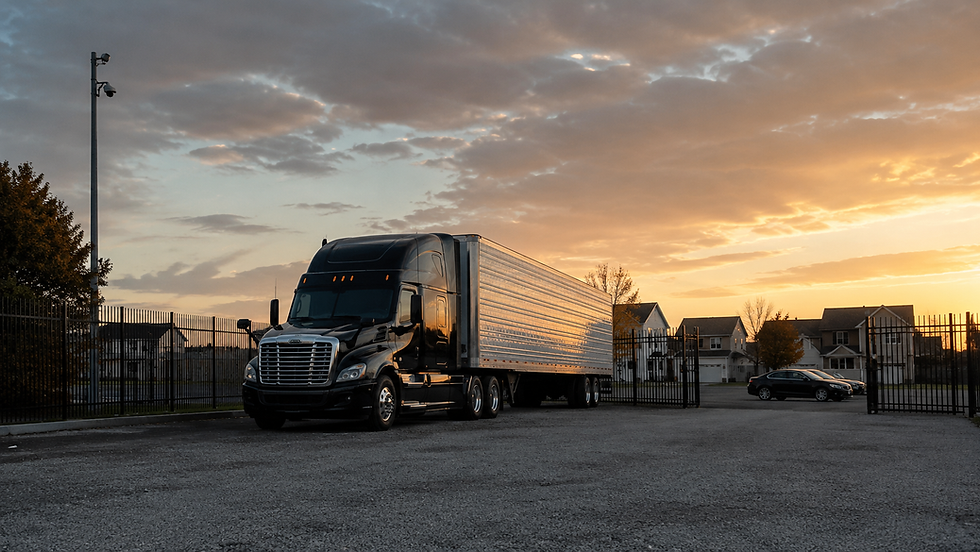
The KP Truck Parking and Contractor Storage website lists fencing, lighting, and video surveillance. Ask how those features apply to the space offered for your unit. Record an incident contact and reporting process so observations reach the responsible operator.
What does reliable winter access require?
Reliable winter access requires an approved entry method, a usable route to the space, snow-removal responsibilities, and retrieval procedures. Separate customer access from office hours. Confirm whether inspections, towing assistance, and midseason departures require appointments, advance notice, or additional charges.
A facility advertising round-the-clock customer access does not necessarily provide round-the-clock staffed assistance. Ask who answers an access failure outside office hours and whether the operator offers emergency support.
Snow removal requires detail. Identify whether the operator clears entrances, driving aisles, pedestrian routes, and individual stalls. Clarify who removes snow beside the trailer and who clears accumulated material around couplers or wheels. Keep owner work within the facility's rules.
Drainage affects access during thawing. Observe low areas, standing water, rutting, and the direction of runoff. Ask how the assigned space behaves during freeze-thaw periods. A dry tour on one afternoon does not establish year-round conditions.
Parking surface and support arrangements belong in the same discussion. Confirm whether the surface accommodates the equipment's weight and whether approved pads are required beneath jacks or trailer supports. Never substitute loose improvised supports for the manufacturer's procedure.
Exit planning deserves attention before the first snowfall. Ask whether surrounding equipment is stored in a way that blocks your departure. Shared indoor storage sometimes involves coordinated movement. Record who moves units and how much notice retrieval requires.
Electrical access also affects movement. Establish how charging cords are routed and disconnected before departure. A cord across an aisle creates a different operational problem from an outlet beside a designated stall.
Which RV systems require winterization before storage?
Prepare RV plumbing with the procedure for the model and installed appliances. Address tanks, lines, pumps, fixtures, drains, and water-heating equipment. Use approved products and specified pressure limits. A parking space, cover, or outlet does not establish system freeze protection.
Winnebago's Operator Manuals provide model-year documentation. Read the storage section alongside manuals for separately installed appliances. Record modifications, because an added filter, washing machine, or outside shower changes the system requiring preparation.
Airstream's Winterization Guide: How to Winterize an Airstream Travel Trailer explains the risk from trapped water and describes drainage and winterization procedures. Its pressure limits and quantities apply to the covered procedure, not every camper or motorhome.
Create a component inventory before starting work. Include the fresh-water system, gray-water and black-water holding systems, water heater, outside fixtures, filters, pumps, and accessory appliances. Gray water comes from washing fixtures. Black water contains toilet waste. Emptying holding tanks alone does not prepare all connected components.
Follow the approved sequence for cooling, depressurizing, draining, bypassing, and treating equipment. Hot or pressurized systems require the manufacturer's safety steps before opening them. Do not copy one universal compressor setting from a general checklist.
Use only antifreeze approved for the intended RV potable-water application where the manual specifies it. Automotive engine antifreeze is not an interchangeable drinking-water-system product. Keep treatment instructions, product labels, and service records with the RV's maintenance documents.
Arrange qualified service when the installed system or winterization method is unclear. Request a work order identifying the unit and the systems treated. A dated service record distinguishes completed preparation from an assumption that someone handled it.
Keep water systems winterized during storage. Adding water for a midwinter visit changes the protection status and requires an appropriate restoration procedure before freezing exposure resumes.
Which boat systems require preparation before land storage?
Prepare the boat's engine, water-containing systems, hull, trailer, and removable equipment. Follow boat and engine manuals separately. Maintain drainage and protect against water intrusion. Storage does not include lifting, blocking, winterization, covering, or launching unless the agreement lists those services.
Mercury Marine's How To Store Your Boat for Winter identifies draining water-containing systems, preventing water intrusion, and removing vulnerable soft goods as core preparation tasks. Keep any storage position and drainage arrangement consistent with the boat, engine, and trailer instructions.
An outboard is an engine mounted outside the hull. A sterndrive combines an inboard engine with an external drive assembly. Their winterization requirements differ. Mercury's How to Winterize Your Outboard directs owners to model-specific procedures and distinguishes fuel-system and engine configurations. Do not apply an outboard checklist to every propulsion system.
Inventory installed systems before booking service. A fishing boat's livewell, a cabin boat's plumbing, and a personal watercraft's cooling passages require different treatment. A livewell holds water for fish or bait. Identify every water-containing accessory rather than treating the engine as the entire boat.
Ask the marine technician to document the engine model, work performed, and any unresolved condition. Retain receipts for winterization and related repairs. Coordinate storage delivery after the work is complete, especially when the storage operator prohibits on-site servicing.
Confirm trailer roadworthiness before towing. Arrange inspection of its tires, wheels, bearings, brakes, lights, coupling, and securing equipment using the trailer manufacturer's guidance. Storage suitability does not establish towing suitability.
Boats without trailers require approved handling and support. Confirm who supplies the lifting equipment and supports, who positions the boat, and who accepts responsibility for that operation. A general parking yard is not automatically a marina or boatyard.
Prepare a spring retrieval note listing removed components, drainage changes, and tasks required before launch. This prevents winter-storage decisions from disappearing between seasons.
How do covers, ventilation, and pest prevention work together?
Exterior protection and interior dryness require compatible covers, drainage, ventilation, and inspection. Remove food and moisture sources. Address pest entry without blocking required vents or drainage. Covers protect surfaces when their fit, support, and installation match equipment and winter exposure.
A cover plan includes more than purchasing material. Identify its approved attachment points, support method, inspection access, and removal procedure. Confirm whether the facility permits fitted RV covers, boat covers, or professionally installed shrink wrap.
Mercury Marine's winter-storage guidance discusses supported covers, ventilation, and dry storage of cushions and other soft goods. Use the cover manufacturer's instructions for attachment and care. A generic tarp is not evidence of suitable snow-load performance or protection against abrasion.
Inspect rubbing points near ladders, corners, windshield edges, boat rails, and trailer hardware. Photograph the installed arrangement. Request corrections from the installer when the cover sags, contacts vulnerable surfaces, or prevents necessary drainage.

Indoor moisture management also requires observation. Remove damp textiles, clean spills, and inspect known leak locations before parking. Record staining, odors, and existing damage. A moisture absorber does not repair a roof leak or establish a controlled indoor environment.
The Environmental Protection Agency's Identify and Prevent Rodent Infestations guidance for buildings recommends removing food and water sources and sealing entry points. Apply that principle only where equipment manuals permit it. Do not block appliance combustion-air openings, exhaust outlets, safety vents, or required drainage paths.
Keep pest-control products within their label instructions and the facility's rules. Avoid presenting scented household products as verified rodent protection. Ask whether the operator manages the surrounding property and how customers report signs of activity.
Record every temporary screen, plug, or protective insert installed for storage. Put its removal on the spring checklist. An undocumented barrier creates a recommissioning problem when a system is later operated.
How do you manage batteries and electrical access safely?
Battery storage depends on chemistry, model, charger compatibility, temperature limits, and connected loads. Obtain manufacturer instructions before charging or disconnecting. Confirm electrical uses and circuit conditions. An outlet does not establish approval for shore power, unattended appliances, or continuous charging.
Lead-acid batteries and lithium batteries require different storage procedures. Flooded lead-acid batteries contain liquid electrolyte. AGM batteries use absorbent glass mat construction. Lithium iron phosphate batteries, often labeled LiFePO4, have their own charging and temperature requirements.
Trojan Battery's Guides and Manuals provide chemistry-specific documentation. Follow the applicable guide for storage, charging, ventilation, and load management. Never charge a frozen or visibly damaged battery. Use a charger approved for the actual battery type.
Victron's Lithium Battery Smart Safety Precautions specifies temperature restrictions for that product. Those values do not define every lithium battery. Verify the battery's permitted charging range, any internal heating system, and its battery-management-system instructions.
A battery management system, or BMS, monitors and protects specified battery operating conditions. Its presence does not justify ignoring the manufacturer's charging limits. Record the exact battery and charger models before choosing a winter plan.
Parasitic loads are devices that continue drawing power while the vehicle appears inactive. Identify those loads with the equipment documentation. Keep alarm and safety-system decisions separate from ordinary accessory shutdown. Never disable required safety devices in an occupied unit.
RV storage with electricity requires approval for the intended equipment and connection. Ask whether charging is permitted, whether power is included, and what happens during an outage. Confirm cord routing and inspection responsibilities. A battery-tender outlet is not a full RV connection.
Shore power is an external electrical supply connected to the vehicle or boat. A charging permission does not define the connection's voltage, available current, or compatibility with onboard equipment. Provide the operator with the intended device and connection requirements. Obtain approval before installing adapters or running cords. Ask whether staff notifies customers about interruptions or whether checking power remains your task.
Keep a record of battery condition, charging arrangements, and disconnections at drop-off. Mark reconnection tasks for retrieval. A repeatable record is more useful than an unsupported universal instruction to leave every battery plugged in all winter.
Which mechanical, fuel, and propane requirements affect winter storage?
Prepare tires and mechanical systems using separate manufacturer instructions. Verify storage pressures, maintenance, fuel procedures, generator shutdown, and propane rules. Equipment remains inactive under defined conditions, not one universal checklist. Never operate engines or fuel-burning generators inside enclosed storage buildings.
What requires attention on tires and running gear?
The National Highway Traffic Safety Administration's TireWise recommends checking tire pressure when cold and consulting the vehicle label or manual. Record pressures before parking and inspect tires before retrieval. A tire-pressure monitoring system does not replace manual checks. Storage instructions and road-use inflation are distinct questions.
Ask the tire manufacturer about the actual application, loading, support surface, and protective coverings. Do not prescribe one pressure for a motorhome, boat trailer, and fifth wheel. Keep the weight-bearing arrangement consistent with chassis and suspension instructions.
Which fuel and engine instructions apply?
Engine storage varies by fuel system and model. Obtain the specified maintenance and fuel-storage procedure. Do not transfer one marine engine's tank-fill instruction to a motorhome or prescribe an additive without compatibility guidance.
What rules apply to generators and heaters?
Cummins' RV Generator Manuals page covers selected models and directs owners to its full manual inventory. Match the generator's model and specification code before following storage or automatic-start instructions. Obtain facility permission before exercising equipment.
The Consumer Product Safety Commission's Keep Warm and Safe This Winter guidance warns against portable-generator use in enclosed spaces and electric-heater connections through extension cords or power strips. Installed RV generators require model-specific exhaust and clearance instructions; never run them inside enclosed storage buildings. Never substitute an unattended heater for winterization.
What propane arrangements require approval?
The Propane Education & Research Council's Safety Guide for Portable Propane Cylinders addresses upright, secured cylinders and safe storage away from ignition sources. Do not store loose portable cylinders in an enclosed garage, shed, or basement. Permanently mounted RV tanks require their own instructions and facility approval.
Resolve fuel and propane acceptance before reserving indoor storage. A building that fits the vehicle still requires operating rules compatible with its installed systems.
What belongs in a monthly or seasonal storage agreement?
A storage agreement defines accepted equipment, assigned area, dates, charges, access, permitted activities, owner duties, and facility responsibilities. Obtain terms before delivery. Confirm whether parking includes documented services. The signed agreement defines each party's scope and responsibilities throughout the term.
Monthly storage and seasonal storage involve different departure planning. A monthly arrangement bills in recurring periods. A seasonal package establishes a defined storage interval. Neither label alone explains minimum commitments, cancellation notice, automatic renewal, or early retrieval charges.
Review these eight subjects before signing:
Confirm the equipment description and accepted dimensions.
Identify the storage type and assigned location.
Record the start date, billing period, and retrieval deadline.
List rent, deposits, electricity charges, and additional fees.
Define access hours, notice requirements, and authorized visitors.
Clarify cover installation, inspections, repairs, and prohibited activities.
Specify snow removal, equipment movement, and incident reporting.
Document cancellation, renewal, late payment, and abandoned-property provisions.
Ask whether an assigned space remains yours throughout the agreement or whether the operator can relocate equipment. Clarify who moves it, whether the owner supplies keys, and how condition is documented before and after movement.
Written permission matters for maintenance. A facility accepting parked equipment does not automatically allow oil changes, battery removal, engine running, wastewater disposal, or work by outside contractors. Obtain permission for the exact activity.
Shared indoor arrangements require a key-handling decision. Record whether staff keeps keys, which movements are authorized, and whether contractors receive access. Ask how the operator documents a relocation and reports accidental damage. Retain a copy of any authorization alongside the main agreement.
Keep contact information current. Add an authorized backup contact when the agreement permits one. Record who receives notices and how the operator contacts you about leaks, access problems, or equipment requiring movement.
Compare commitments against your plans. Owners expecting a midwinter departure require workable retrieval terms. Owners storing until spring require clarity about the end date and any extension. Resolve conflicting wording with the operator before payment.
What insurance questions require answers before storage?
Confirm insurance for the equipment, storage address, period, and risks. Ask about theft, weather damage, freezing exclusions, deductibles, valuation, trailers, and belongings. Facility security and the operator's insurance do not establish coverage for your property. Policies and endorsements control coverage.
Progressive's RV Comprehensive and Collision Coverages distinguishes comprehensive coverage for specified noncollision events from collision coverage. Read your selected policy with the insurer. Do not assume that being parked removes every exposure or that a facility's liability policy replaces your own coverage.
BoatUS describes an optional ice-and-freeze endorsement in its Agreed Hull Value Coverage information. Its conditions include manufacturer-specified winterization by a commercial marine facility and appropriate storage. Ask your insurer about freeze exclusions, endorsement conditions, and supporting records. Requirements vary by policy; a service receipt alone does not guarantee coverage.
Provide the insurer with the correct storage address and arrangement. Describe outdoor or indoor placement, the intended lay-up period, and any midwinter travel. A lay-up period is a policy-defined interval when vessel use is restricted or treated differently. Verify whether that concept applies to your policy.
Ask separate questions about the hull or RV body, engine, trailer, accessories, and personal effects. Equipment stored together does not necessarily share identical coverage or deductibles. Confirm any lender requirements before changing coverage.
Preserve the storage agreement, condition photographs, winterization receipts, and relevant correspondence. Keep copies accessible outside the stored unit. These records support accurate reporting without establishing that a future claim will be paid.
Arrange coverage questions before the final tow. The trip to storage and the return trip remain separate operating events. Confirm the policy requirements for both rather than considering only the stationary winter period.
How much does winter RV and boat storage cost?
Winter RV and boat storage costs depend on equipment size, storage type, dates, and services. Request rent, fees, electricity, preparation, transport, and retrieval charges in writing. Compare equivalent arrangements; the monthly rate alone does not show the total seasonal expense.
Use this comparison formula:
Total planned winter cost = storage rent + required fees + preparation + transport + optional services.
A hypothetical five-month arrangement at $150 per month produces $750 in rent. Adding a $40 administration fee and $60 in electrical charges produces $850 before winterization, covers, insurance, or travel. These figures illustrate arithmetic only. They are not prices from KP Truck Parking and Contractor Storage, local averages, or estimates of your final cost.
Request each quote for the same measured equipment and dates. Clarify whether pricing uses stall size, total trailer length, vehicle category, or a seasonal package. A boat-only length quote is not comparable with a complete boat-and-trailer footprint quote.
Record electricity separately. Ask whether power is included, metered, billed as a flat charge, or unavailable for the intended use. Do not value an outlet as a benefit until its permitted use matches your battery plan.
Transport and access affect the budget. Compare distances for drop-off, inspections, and retrieval. Include outsourced towing or marine handling when required. Evaluate savings from your actual route and expenses, not an unspecified estimate.
Distinguish included work from optional work. A winterization package, professional cover installation, snow clearing around individual units, and spring recommissioning are different services. List the provider responsible for each item.
Evaluate value after defining the scope. The strongest quote identifies the actual space, conditions, dates, and charges. It also leaves fewer unresolved responsibilities for the owner to discover after the equipment is parked.
Use acceptance and fit as exclusion criteria before comparing prices. Remove any option that lacks confirmation for your equipment or requires access you cannot use. Compare the remaining arrangements by documented protection, owner workload, and total cost. This order prevents a discounted rate from overriding a basic incompatibility that appears only after delivery.
What happens at drop-off and during winter inspections?
Drop-off establishes documented equipment condition and the storage arrangement. Confirm the space, photograph the unit, secure it using approved procedures, and record access instructions. Winter inspections check changes, not just presence. Follow manufacturer guidance and facility rules for every visit.
Prepare one storage record containing the agreement, unit identification, measurements, maintenance documents, battery plan, and retrieval instructions. Keep accessible copies at home. Include the operator's office contact and the process for reporting an urgent concern.
At arrival, compare the assigned space with the quoted arrangement. Verify usable dimensions, electrical permission, aisle clearance, and storage type. Resolve changes before unhitching or handing over keys. A different stall or building requires a fresh fit check.
Photograph the exterior, roof where safely observable, interior condition, trailer, tires, cover, and visible accessories. Record existing damage accurately. Do not climb onto a snowy roof or use an unstable ladder to complete a photograph.

Complete a final walkthrough using the equipment's procedure. Record drained systems, disconnected accessories, secured doors, removed valuables, and installed protective measures. Confirm that nothing extends into a driving aisle or neighboring space.
Build inspections around manufacturer requirements and changing conditions. Relevant triggers include strong winds, heavy snowfall, thawing, a reported power outage, and suspected cover damage. Coordinate access with the operator rather than assuming staff performs owner inspections.
During each visit, compare current conditions with the initial photographs. Look for changed cover tension, water entry, pest activity, damaged locks, tire problems, and obstructed access. Report a concern promptly and document the response.
Keep inspection work safe and permitted. Avoid entering under damaged coverings or disturbing heavy ice. Use qualified assistance for repairs and removal tasks beyond safe owner access. Record any change to winterization status, electricity, or storage configuration before leaving.
How do you plan spring retrieval and recommissioning?
Plan retrieval before the term ends and restore equipment through manufacturer-approved procedures. Confirm access, remove documented storage protections, inspect roadworthiness, and arrange qualified service where required. Departure does not establish that a motorhome is travel-ready or a boat is launch-ready.
Recommissioning means returning stored equipment to safe, approved operating condition.
Contact the operator about retrieval notice, final billing, aisle access, and any coordinated equipment movement. Ask whether remaining snow or wet ground affects departure. Do not arrive with a tow vehicle before confirming that the exit route is usable.
Use the storage record to identify removed batteries, temporary pest barriers, cover supports, isolated systems, and disconnected accessories. Account for every item. Inspect beneath coverings before removing them completely, and arrange safe removal of accumulated snow or ice.
Restore water systems according to the RV or boat manual, including applicable flushing, sanitizing, leak testing, and appliance procedures. Remove bypass arrangements only when the relevant instructions specify the correct sequence. Do not energize empty water-heating equipment.
Inspect tires and obtain the correct operating pressures before travel. Check lights, brakes, coupling, wheel condition, and trailer securing equipment through the applicable guidance. Schedule service for unexplained damage or deterioration rather than treating a successful engine start as a complete inspection.
For boats, verify launch preparation separately. Confirm all required plugs, fittings, connections, and components are restored and checked. A winter drainage configuration is not the launch configuration. Use a marine technician when the remaining steps or engine condition are unclear.
Remove charging cords and account for locks before moving. Return access items or keys as the agreement requires. Photograph the equipment at retrieval and report any discrepancy through the operator's established process.
Update the record after the first service or trip. Note which storage conditions worked, which responsibilities caused difficulty, and whether the next winter requires a different space or preparation plan.
How does location affect winter storage in Northern Illinois?
Choose storage in Northern Illinois by travel routes, equipment fit, inspection convenience, and winter access. Volo is in Lake County. Owners traveling from Fox Lake, Wauconda, McHenry, and surrounding communities require confirmed services at the facility, not assumed local availability.
Local searches such as RV storage near Fox Lake, boat storage near Wauconda, or motorhome storage near McHenry describe different starting points. They do not change a facility's physical address. Compare the actual route from your home, service provider, and planned spring destination.
The contact page for KP Truck Parking and Contractor Storage publishes 30846 N US Highway 12, Volo, IL 60073. Use that address for directions, insurance, and appointments. McHenry describes a separate customer origin, not the facility's physical location. Calculate travel from your actual starting point.
Boat owners also require coordination with marine service. Confirm where winterization, cover installation, and trailer inspection occur before storage delivery. A convenient yard does not replace a provider equipped to handle a boat without a trailer.
Motorhome owners require a workable route for the complete vehicle. Confirm the storage approach and any route restrictions relevant to the equipment. Avoid choosing a facility solely from a straight-line distance on a map.
Inspect local options using the same written checklist. Apply identical questions about dimensions, winter access, electricity, security features, agreement terms, and spring retrieval. This produces a comparable decision rather than a collection of unrelated marketing claims.
Choose a nearby space only after confirming fit, winter access, and operating terms.
What can owners verify about Kanzler Properties Truck Parking and Contractor Storage before inquiring?
The facility publishes fencing, lighting, 24/7 video surveillance, and 24/7 access. Services describe indoor and outdoor contractor storage and plug-ins for block heaters and battery tenders. Confirm recreational-equipment acceptance, dimensions, access procedures, current availability, pricing, and written storage terms before delivery.
The company's Truck Parking & Contractor Storage page lists facility features, including easy entry and exit. Its published office hours are Monday through Saturday, 9 a.m. to 5 p.m., with Sunday by appointment. Customer access and staffed office availability remain separate matters.
The Truck Facility Services: Parking, Storage & Repair page describes contractor storage for vehicles and work equipment, with indoor and outdoor options. It also describes electric plug-ins for engine block heaters and battery tenders. This information does not establish heated RV bays, marine winterization, covered boat parking, or full RV shore-power connections.
Provide KP Truck Parking and Contractor Storage with overall dimensions, trailer configuration, storage dates, and electrical needs. Request written confirmation of acceptance, storage type, access procedures, price, and availability. Ask whether requested mechanical work falls within its truck-and-trailer services. Marine engines and RV water systems require separate confirmation or a qualified provider.
Use Secure 24/7 Truck Parking & Storage to review the booking and waitlist page. A reservation inquiry does not establish an open space. Confirm availability with the operator before traveling.
Call 847-526-0154 or contact KP Truck Parking and Contractor Storage. Provide your unit details and intended winter dates. Request written confirmation of acceptance and terms before making delivery arrangements.
Which questions clarify winter RV and boat storage terms?
Clarify required documents, reservation timing, relocation authority, blocked access, included services, and occupancy rules before booking. These details define how the storage arrangement operates. Ask the operator for written answers specific to your unit and dates, then retain that information.
What documents are required at move-in?
Ask for the operator's document list before delivery. Typical inquiry subjects include identification, registration, proof of ownership or authority, insurance information, equipment photographs, and emergency contacts. Requirements vary by facility. Provide only requested information through the approved process, and clarify how authorized drivers or contractors receive access.
How early do you reserve winter storage?
Request availability when you know the equipment configuration and dates. Ask about the facility's reservation deadline, deposit, cancellation terms, and waitlist. An inquiry is not a confirmed booking. Schedule winterization separately and obtain written space confirmation before arranging transport.
Can the operator relocate your unit?
Relocation authority depends on the agreement. Identify permitted movements, authorized personnel, key handling, notification, and condition documentation. Ask whether the destination provides equivalent storage conditions and whether electricity remains available. Resolve the terms before granting movement authority, especially in shared indoor storage.
What happens when snow blocks retrieval?
Follow the agreed access and snow-removal procedure. Contact the operator before bringing a tow vehicle, describe the blocked area, and obtain a retrieval plan. Customer access permission is not a promise of immediate clearance after every storm. Do not attempt departure through an unsafe route.
Are electricity and inspections included in the rate?
The quote and agreement define included services. Ask what electrical use is permitted, which charging conditions apply, what inspections include, how results are reported, and which charges are additional. An outlet listing does not include owner inspections. Record owner and operator tasks separately.
Can you stay overnight in a stored motorhome?
Storage permission does not authorize occupancy. Ask whether overnight stays or habitation are allowed. A battery-tender outlet is not a campground connection. Do not treat a vehicle-storage agreement as a camping arrangement or operate equipment contrary to the facility's rules.
What is the final checklist before choosing winter storage?
Choose storage after confirming acceptance, fit, winter access, security features, preparation responsibilities, insurance requirements, and complete charges. Match the agreement to the equipment and intended dates. Unresolved answers remain selection gaps, not benefits. Obtain written terms before payment or delivery.
Use these seven checks for boats, RVs, and motorhomes:
Confirm the exact unit is accepted in the available storage type.
Verify the complete footprint, approach, support surface, and retrieval route.
Inspect fencing, lighting, surveillance coverage, and incident procedures.
Clarify winter access, snow clearing, electrical permission, and owner inspections.
Complete equipment-specific winterization and retain service records.
Review insurance, responsibilities, dates, cancellation terms, and total cost.
Document drop-off condition and plan safe spring recommissioning.
For the Volo facility, contact Kanzler Properties Truck Parking and Contractor Storage to confirm acceptance, availability, and written terms for your boat, RV, motorhome, or trailer before arrival.


Comments