_edited.jpg)
Where Can Owner-Operators Park Their Truck During Home Time?
Updated: Sep 3
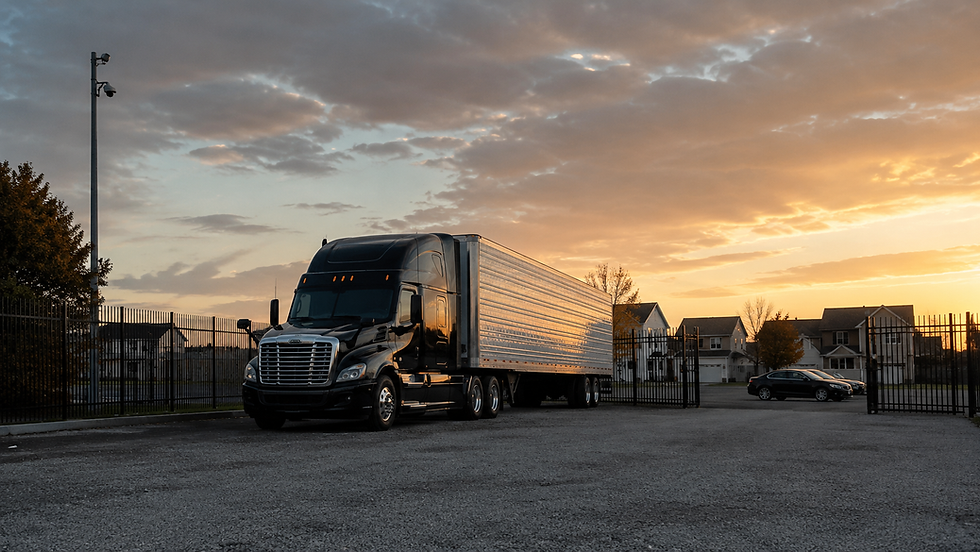
Owner-operators can arrange truck parking during home time at dedicated commercial truck parking facilities, authorized carrier terminals, approved drop yards, permitted commercial or industrial properties, and private property where local regulations allow commercial vehicle storage. For recurring home time, assigned monthly truck parking provides the most predictable arrangement.
Finding somewhere to park for a 30-minute break, a 10-hour off-duty period, and 5 days of home time are 3 different parking problems.
Semi truck home time parking requires a location where the tractor, trailer, or complete combination can remain legally, securely, and accessibly for the entire time the driver is home.
The parking location also has to fit the driver's operating pattern.
An owner-operator who returns home every weekend needs a different parking system from a driver who stays on the road for 3 weeks and then spends 7 days at home. A driver returning bobtail has different space requirements from an owner-operator returning with a 53-foot trailer. A loaded reefer creates different considerations from an empty dry van.
The central question remains the same:
Where will the truck stay when the owner-operator goes home?
A dependable answer removes parking uncertainty from every future trip.
According to the Federal Highway Administration's Jason's Law survey findings, 98% of participating truck drivers reported problems finding safe parking, and the Chicago region was specifically identified among the areas experiencing significant parking challenges. Illinois was also among the states drivers cited most frequently for parking shortages.
The Illinois Department of Transportation currently reports that public facilities supply only about 15% of Illinois truck parking, while Interstate safety rest-area truck spaces average approximately 94% utilization.
Those figures primarily describe freight-network parking, but the same limited parking environment affects drivers returning to the Chicago and northern Illinois markets for home time.
A reliable home-time parking system therefore solves 5 interconnected requirements:
Establish where the truck can legally remain.
Confirm that the space accommodates the actual equipment.
Verify that access matches the driver's arrival and departure schedule.
Protect unattended equipment with an appropriate security plan.
Position the truck where both home and the next freight movement remain practical.
This guide explains each option and shows how owner-operators can build a consistent home-time parking system rather than solving the same parking problem after every trip.
Where Can Owner-Operators Park Their Truck During Home Time?
Owner-operators have 6 primary home-time parking options: dedicated commercial truck parking, authorized carrier terminals, approved drop yards, truck stops that permit extended stays, authorized commercial or industrial property, and residential property where local rules permit commercial vehicle storage. Monthly truck parking best serves recurring home-time use.
Each parking option solves a different requirement.
Parking option | Strongest use | Multi-day suitability | Predictability | Permission requirement |
Dedicated truck parking facility | Regular home time | High | High with assigned space | Commercial agreement |
Monthly truck parking | Permanent home base | High | High | Commercial agreement |
Carrier terminal | Carrier-based operations | High | High when approved | Carrier authorization |
Drop yard | Tractor or trailer staging | High | High when approved | Yard authorization |
Truck stop | Road rest or short stay | Facility-specific | Variable | Facility rules |
Commercial/industrial property | Negotiated local parking | Agreement-specific | High with written approval | Property authorization |
Residential private property | Home storage | Local-rule-specific | High | Local/property rules |
Residential street | Generally poor recurring option | Frequently restricted | Low | Local law controls |
The difference between road parking and home-time parking is duration and predictability.
A road stop answers:
"Where can I stop tonight?"
A recurring home-time arrangement answers:
"Where does my truck go every time I come home?"
The second question carries greater operational value because the answer can remain constant across dozens of trips.
What Does Truck Parking During Home Time Mean?
Truck parking during home time means storing a commercial tractor, trailer, straight truck, box truck, or tractor-trailer while the driver is away from active freight operations and spending time at home. The parking period can cover one night, a 34-hour restart, several days, or a longer scheduled break.
"Home time" is an industry term.
It is not a separate FMCSA duty-status category.
The driver can be off duty at home while the commercial vehicle remains at another authorized location.
The parking location and the driver's duty status therefore represent separate entities:
Driver status: Determines whether the driver is driving, on duty, in the sleeper berth, or off duty.
Vehicle location: Determines where the tractor and trailer physically remain.
That distinction matters because completing home time does not require parking the truck at the driver's residence.
An owner-operator can:
Park commercial equipment at an authorized truck lot → leave in a personal vehicle → complete home time at home → return to the parking facility → resume operations.
This arrangement separates residential life from commercial equipment storage.
It also explains why monthly truck parking functions as a home-base service rather than simply another overnight parking product.
Why Does Semi Truck Home Time Parking Require Advance Planning?
Semi truck home time parking requires advance planning because truck spaces are limited, commercial vehicle parking is restricted in many residential areas, trailers require more space than tractors alone, and an unattended vehicle can remain parked for several days. Selecting the location before the final trip segment removes those uncertainties.
According to FHWA's Jason's Law findings, 98% of responding drivers reported difficulties finding safe truck parking. Drivers reported particularly significant problems along major freight corridors, including the Chicago region.
According to IDOT, Interstate safety-rest-area truck parking in Illinois averages approximately 94% utilization. IDOT also states that drivers regularly resort to roadsides and automobile parking areas when available capacity is insufficient.
Home time creates an additional parking problem because the equipment remains stationary longer.
Compare 3 parking durations:
30 minutes: Short break.
10 hours: Full off-duty period for a standard property-carrying driver's next driving period.
5 days: 120 hours of equipment storage.
The physical parking space might look identical.
The required authorization does not.
A facility permitting overnight parking does not automatically permit unattended equipment storage for 120 hours.
That makes duration one of the first attributes an owner-operator needs to verify.
The stronger operating sequence is:
Choose parking → verify access and authorization → plan the final route → arrive with available driving time → secure equipment → begin home time.
The weaker sequence is:
Finish the load → enter the home area → search for somewhere to leave the truck.
Parking becomes easier when it is treated as part of trip planning rather than a problem discovered at the end of the trip.
Why Is Long-Term Parking During Home Time a Distinct Trucking Need?
Long-term home-time parking is a distinct trucking requirement because owner-operators need vehicle storage after freight movement stops. Highway rest areas primarily support active travel, while monthly truck parking supports recurring equipment storage between trips, especially when residential truck parking is unavailable or impractical.
Truck parking research has specifically recognized this use case.
A statewide truck-parking study conducted for the Texas Department of Transportation documented driver demand for longer-term storage facilities, including owner-operators who needed places to park their trucks while home for breaks.
That finding identifies an important difference between 2 truck-parking markets:
En route parking: Serves drivers completing a current freight movement.
Storage parking: Serves equipment between freight movements.
Home-time parking belongs to the second category.
The parking needs are consequently different.
A home-time facility needs to answer:
Can the vehicle remain unattended?
Can the space be used repeatedly?
Is a trailer allowed?
Can the driver leave a personal vehicle?
Can the truck be accessed during overnight hours?
Is the parking term daily, weekly, or monthly?
What happens when the driver stays home longer than expected?
What vehicle configurations are accepted?
These are recurring-storage questions rather than rest-stop questions.
That is why monthly truck parking, long-term truck parking, owner-operator truck parking, and truck parking near home often represent the same underlying search intent.
The driver needs an operating base.
Is It Legal to Park a Semi Truck at Home?
Parking a semi truck at home is legal only when the applicable municipal code, zoning rules, property restrictions, access requirements, lease terms, and association rules permit commercial vehicle storage at that property. A driveway large enough for a tractor or trailer does not automatically establish legal permission.
Residential parking requires 4 separate tests.
Does the truck physically fit?
Confirm:
Tractor length
Trailer length
Combined configuration
Driveway width
Turning radius
Gate width
Vertical clearance
Ground or pavement condition
Ability to remain entirely on the permitted property
A physical fit answers only the space question.
Does local law permit the vehicle?
Municipalities regulate commercial vehicles differently.
Rules can distinguish between:
Truck
Tractor
Truck tractor
Semi-trailer
Trailer
Commercial vehicle
Vehicle weight
Vehicle length
Overnight parking
Outdoor storage
The vehicle's legal status therefore depends on the jurisdiction.
Can the truck legally reach the property?
A residential property can theoretically allow truck storage while the access route creates another problem.
Verify applicable:
Truck-route restrictions
Weight limits
Bridge limits
Local commercial-traffic rules
Posted access restrictions
The final 2 miles matter as much as the driveway.
Do private property rules allow the truck?
HOAs, landlords, condominium associations, property covenants, and lease agreements can impose separate restrictions.
The correct sequence is:
Verify law → verify zoning → verify route → verify private restrictions → confirm physical fit.
That sequence prevents a large driveway from being mistaken for an automatically legal truck-parking facility.
Can an Owner-Operator Park a Semi Truck on a Residential Street?
Residential street parking is not a dependable home-time strategy because municipalities frequently restrict trucks, tractors, trailers, and commercial vehicles in residential areas. The owner-operator must verify the current municipal code for the exact street before treating curb space near home as commercial truck parking.
A street can physically accommodate a tractor-trailer and still prohibit it.
Street width answers:
"Can the truck fit?"
The municipal code answers:
"Can the truck legally remain?"
Those are different questions.
Chicago provides a clear example.
Chicago Municipal Code Section 9-64-170 states that, except for specified exceptions, it is unlawful to park a truck, van, tractor, truck tractor, semi-trailer, trailer, qualifying recreational vehicle, bus, taxicab, commercial vehicle, limousine, or livery vehicle on a residential street at any time, including overnight.
This rule does not govern every suburb, town, village, or county around Chicago.
Each jurisdiction requires its own verification.
The broader principle remains constant:
"Near my home" does not mean "authorized for my commercial truck."
A commercial parking facility solves that uncertainty by establishing a location intended for vehicle parking under the facility's operating terms.
Does a Large Driveway Make Semi Truck Home Parking Legal?
A large driveway solves the physical-space requirement but not the legal-storage requirement. A tractor or trailer can fit entirely on private property and still conflict with zoning, commercial vehicle regulations, lease restrictions, homeowners-association rules, or truck-access restrictions on the roads leading to the residence.
Use 4 tests.
Test 1: Physical compatibility
Measure the actual truck configuration.
A sleeper tractor with a 53-foot trailer creates a different turning requirement from a day cab operating bobtail.
Check:
Length
Width
Turning path
Rear swing
Grade
Surface
Overhead obstructions
Test 2: Regulatory compatibility
Determine whether the property is legally allowed to store the vehicle.
The correct authority depends on the property.
Test 3: Route compatibility
Confirm the truck can lawfully travel between the commercial road network and the residence.
Test 4: Operational compatibility
Evaluate:
Early departures
Late arrivals
Engine starting
Reefer operation
Snow accumulation
Neighbor impact
Backing visibility
Personal vehicle movement
A home driveway becomes a practical solution only when all 4 tests pass.
Failure in one category creates a reason to use dedicated commercial parking instead.
Can Owner-Operators Use Truck Stops During Home Time?
Truck stops work well for fueling, meals, mandated rest, overnight parking, and other en route needs, but they do not automatically provide multi-day home-time storage. Extended parking depends on the individual property's rules, paid-parking program, reservation system, trailer policy, and maximum authorized parking duration.
Truck stops primarily serve active trips.
A monthly parking facility primarily serves recurring storage.
That difference affects space certainty.
A truck stop often operates around available spaces or reservations for a specific period.
A monthly parking facility can establish an ongoing relationship between:
vehicle → authorized space → recurring parking term
Truck stops remain valuable for:
Overnight road stops
Fuel
Food
Showers
HOS breaks
Temporary staging when authorized
Trip-specific parking
They become less predictable as a permanent home-time base when no extended arrangement exists.
An owner-operator going home for 4 days needs approximately 96 hours of continuous parking.
The correct question is therefore not:
"Does this truck stop allow overnight parking?"
The correct question is:
"Does this property authorize my specific tractor and trailer to remain here unattended for the entire period?"
Never infer multi-day permission from the presence of other parked trucks.
Verify the facility's current rules.
Can an Owner-Operator Leave a Truck at a Public Rest Area During Home Time?
Public rest areas provide parking for highway travelers and required rest periods. They do not automatically provide long-term equipment storage. Maximum-stay limits, unattended-vehicle rules, and enforcement conditions vary, so a driver must verify the applicable rules before using a public facility beyond its intended travel function.
IDOT currently reports approximately 94% average utilization of existing truck spaces at Interstate safety rest areas in Illinois.
That statistic demonstrates why public parking capacity matters to drivers actively moving freight.
It also highlights the difference between public travel infrastructure and private storage infrastructure.
A driver occupying a space for a legally required rest period uses the rest area as part of active travel.
A tractor-trailer sitting for 5 days while its driver is home represents a different use.
Dedicated monthly truck parking creates explicit authorization for recurring storage.
The facility exists to accommodate commercial vehicles under defined parking terms.
That produces greater certainty than treating a public rest area as a home-base lot.
Can Owner-Operators Park at a Carrier Terminal During Home Time?
A carrier terminal provides effective home-time truck parking when the carrier authorizes the owner-operator's equipment and the facility permits the required parking duration. Terminal parking works especially well when dispatch, fueling, maintenance, trailer exchange, or the next freight movement already connects to the same location.
Leased owner-operators often have more carrier infrastructure available than fully independent operators.
Potential options include:
Carrier terminals
Fleet yards
Maintenance locations
Trailer pools
Drop lots
The carrier's actual policy controls access.
Confirm:
Confirm that owner-operators can park there.
Confirm the permitted duration.
Confirm whether trailers are accepted.
Confirm loaded-trailer restrictions.
Confirm personal-car parking.
Confirm gate-access hours.
Confirm the process for late arrivals.
Confirm the process for retrieving equipment.
Location remains important.
A terminal 6 miles from home creates a practical home-time transfer point.
A terminal 70 miles from home requires an additional transportation plan.
That distance converts parking into a commuting decision.
How Does Home-Time Parking Differ for Leased and Independent Owner-Operators?
Leased owner-operators can have access to carrier terminals, fleet yards, or approved drop lots, while independent operators often arrange their own commercial parking. The correct parking strategy depends on the operating agreement, equipment ownership, trailer control, freight network, reimbursement policy, and proximity to home.
A leased owner-operator first checks the carrier agreement and operations policy.
Important questions include:
Is parking supplied?
Is parking reimbursement available?
Which yards can the driver use?
Can a personal car remain at the terminal?
Can a carrier trailer remain unattended there?
Does the carrier require a specific storage location?
An independent owner-operator makes those decisions directly.
That increases flexibility but also shifts responsibility for finding an appropriate location.
The independent operator needs to establish:
Parking provider
Parking term
Tractor space
Trailer arrangement
Loaded-cargo policy
Personal transportation
Monthly cost
Access schedule
Neither structure is automatically better.
The important point is responsibility.
The party responsible for parking needs to solve the home-base question before the truck returns home.
Can an Owner-Operator Use a Drop Yard During Home Time?
A drop yard provides suitable home-time parking when the yard agreement authorizes the driver's tractor, trailer, or both for the required period. Drop yards work particularly well when the trailer remains at the yard and the owner-operator travels home bobtail or switches to a personal vehicle.
A drop yard is a commercial staging location.
Its function can include:
Trailer exchange
Trailer storage
Tractor parking
Relay operations
Empty-equipment staging
Loaded-equipment staging where authorized
A drop yard and a truck parking facility therefore overlap, but their central purposes differ.
Drop yard: Equipment staging within freight operations.
Truck parking facility: Vehicle parking and storage.
Some properties perform both functions.
The important question is not what the property is called.
The important question is whether the agreement covers the specific equipment.
A yard that accepts empty trailers does not automatically accept:
Loaded trailers
Reefers
Flatbeds with cargo
Hazmat loads
Detached tractors
Personal vehicles
Confirm each required use before relying on the location for home time.
Can Private Commercial or Industrial Property Be Used for Home-Time Truck Parking?
Private commercial or industrial property can provide legitimate home-time parking when the property owner authorizes the specific vehicle, the property legally supports the use, the truck can access it, and the agreement defines the parking area, duration, vehicle type, and entry conditions. Written authorization creates greater certainty than informal permission.
An empty industrial lot is not automatically truck parking.
A warehouse manager saying "leave it behind the building" establishes permission only when that person has authority to grant it and the arrangement complies with the property's rules.
Verify:
Property ownership or management authority
Local land-use requirements
Vehicle access
Parking duration
Tractor permission
Trailer permission
Loaded-equipment rules
Gate hours
Towing arrangements
Winter access
Personal-vehicle permission
Written documentation is particularly useful when the vehicle remains unattended.
It identifies:
who authorized parking → which vehicle is covered → where the vehicle belongs → how long it can remain
Dedicated commercial truck parking formalizes those relationships from the start.
Can an Owner-Operator Park at a Shipper or Receiver During Home Time?
A shipper or receiver property can be used only when the property expressly authorizes the extended stay. Completing a delivery does not create a right to leave a tractor or trailer on customer property for home time, and facility rules can require drivers to depart after loading or unloading.
Shippers and receivers use parking for different functions:
Appointment staging
Dock queues
Loading
Unloading
Temporary trailer drops
Authorized overnight parking
None of those automatically equals multi-day equipment storage.
The driver needs explicit permission.
This distinction becomes especially important after the final delivery.
The load may be complete, but the tractor still requires an authorized location.
FMCSA's personal-conveyance guidance also distinguishes movements after shipping and receiving activity from ordinary personal travel.
The parking plan therefore cannot assume:
"I will deliver first and figure out where to leave the truck afterward."
The owner-operator should identify the next authorized location before reaching the final customer whenever home time follows the delivery.
Can Retail Parking Lots Be Used for Semi Truck Home Time?
Retail parking lots are not reliable home-time truck storage unless the property owner or authorized management permits the commercial vehicle to remain for the entire period and local regulations allow the use. A large parking lot does not create automatic permission for unattended multi-day truck or trailer storage.
This applies to:
Big-box retailers
Shopping centers
Grocery stores
Restaurants
Fuel stations without designated truck storage
Vacant commercial lots
Physical capacity is not authorization.
A driver seeing other trucks parked overnight does not establish:
Long-term permission
Trailer permission
Property-owner approval
Multi-day authorization
Use the same verification process applied to any private property.
For recurring home time, a dedicated monthly truck parking agreement provides far greater certainty.
Why Is Monthly Truck Parking Effective for Owner-Operator Home Time?
Monthly truck parking gives an owner-operator a recurring commercial location for a tractor, trailer, bobtail, box truck, or authorized combination between trips. It removes repeated parking searches, supports multi-day home time, creates predictable access, and establishes a consistent transition point between the freight operation and residence.
Monthly parking changes the operating process.
Without a recurring space:
Finish trip → search for parking → verify availability → verify permission → park → arrange transportation → repeat next home time
With assigned monthly truck parking:
Finish trip → return to established location → park → secure equipment → go home
The second process removes several variables.
Monthly truck parking provides 7 practical benefits.
Establish a recurring commercial home base
The driver knows where the equipment belongs after each trip.
Remove repeated parking searches
The parking decision is made once rather than after every home-time return.
Support longer parking periods
A monthly arrangement is structured around recurring storage rather than a single rest period.
Improve dispatch planning
The next commercial movement starts from a known location.
Separate commercial equipment from residential restrictions
The truck remains on commercial property instead of depending on neighborhood parking.
Support multiple vehicle configurations
Facilities can offer full tractor-trailer, bobtail, box-truck, or trailer-specific spaces.
Simplify the home commute
A facility that allows personal-car parking can create a direct transfer between the truck and the driver's home transportation.
These benefits connect the queries:
truck parking during home time
semi truck home time parking
monthly truck parking
owner-operator truck parking
long-term truck parking
truck parking near home
They describe different attributes of the same underlying need.
What Is the Difference Between Overnight, Daily, Weekly, and Monthly Truck Parking?
Overnight parking serves one short stop, daily parking serves temporary storage, weekly parking serves several consecutive days, and monthly truck parking serves recurring commercial vehicle storage. The strongest term depends on how often the owner-operator returns home and how long the equipment remains parked each time.
Parking term | Primary use | Home-time fit |
Overnight | One short stay | Occasional overnight home stop |
Daily | Temporary parking | Irregular short home time |
Weekly | Multi-day storage | Temporary or infrequent extended stay |
Monthly | Recurring storage | Regular owner-operator home base |
KP Truck Parking's current services page verifies overnight, daily, weekly, and monthly parking for full-size truck and trailer spaces. It also states that assigned parking spots are available.
That range matters because owner-operators have different duty cycles.
A driver returning home once can use a shorter parking term.
A driver returning repeatedly can shift the same parking requirement into a monthly arrangement.
The parking term should follow actual operating behavior.
How Can an Owner-Operator Decide Whether Monthly Truck Parking Is Worth It?
Monthly truck parking provides the strongest value when the owner-operator repeatedly returns to the same area, spends multiple days at home, requires predictable space, stores a trailer, needs off-hours access, or cannot legally park commercial equipment at the residence. Compare annual usage rather than judging the monthly fee in isolation.
Start with parking frequency.
Use:
Home-time returns per month × average parked days per return = monthly home-time parking days
Example 1:
4 returns × 2 parked days = 8 parked days per month
Example 2:
1 return × 7 parked days = 7 parked days per month
The first driver comes home more frequently, but the total parking demand is similar.
Next calculate predictability value.
Ask:
Do I need a guaranteed location?
Do I return after midnight?
Does my trailer stay with me?
Can I legally park at home?
Do I need to leave a car?
Do I regularly use the same freight market?
The more "yes" answers, the stronger the case for recurring parking.
The monthly parking decision therefore depends on frequency + duration + uncertainty + operational fit.
How Does Assigned Truck Parking Differ From First-Come Parking?
Assigned truck parking reserves a defined space or parking allocation under the facility's arrangement, while first-come parking depends on availability when the driver arrives. Assigned parking provides greater predictability for recurring home time because the driver does not have to compete for an open space after every trip.
First-come parking works well when:
The visit is occasional
The stay is short
The driver has alternatives
Arrival time is predictable
Assigned parking becomes more valuable when:
The driver returns weekly
Arrival time varies
The equipment stays several days
A trailer requires full-length space
The driver needs a stable home base
The semantic difference is important.
Monthly payment does not automatically mean assigned parking.
Ask the provider how the parking arrangement works.
KP's services page specifically states that assigned parking spots are available for its full-size truck and trailer parking.
That feature connects directly to the home-time use case.
What Should a Monthly Truck Parking Agreement Clarify?
A monthly truck parking agreement should clearly identify the authorized vehicle, parking term, access rules, assigned-space arrangement, trailer permissions, loaded-equipment restrictions, payment terms, cancellation process, personal-vehicle rules, security responsibilities, and contact procedure. Clear terms prevent assumptions from becoming operational problems.
Verify these attributes before committing.
Vehicle identity
Confirm which tractor, truck, trailer, or fleet units the agreement covers.
Parking configuration
Confirm whether the arrangement covers:
Tractor only
Trailer only
Tractor and trailer
Box truck
Multiple trailers
Personal vehicle
Parking duration
Determine the billing period and what happens when the driver needs a longer stay.
Access
Identify the hours when the vehicle can enter and leave.
Space assignment
Confirm whether the driver receives a designated space or general access to available parking.
Loaded equipment
Confirm whether loaded trailers are accepted.
Personal vehicle
Confirm whether a car can remain on the property while the driver is on the road.
Payment terms
Understand billing timing and accepted payment methods.
Cancellation terms
Understand how notice and cancellation work.
Contact process
Know who handles an access issue or parking question.
A clear agreement reduces semantic and operational ambiguity.
The driver knows precisely what has been purchased.
What Features Matter Most in Monthly Truck Parking?
The strongest monthly truck parking facility combines authorized commercial use, sufficient space, dependable access, appropriate security features, commercial-vehicle-friendly maneuvering, equipment compatibility, useful support services, and a location that minimizes unnecessary travel between the driver's home and normal freight routes.
Evaluate the facility in this order.
Confirm the vehicle type
A generic "truck parking" label does not identify every accepted vehicle.
Verify:
Sleeper tractor
Day cab
Tractor-trailer
Bobtail
Box truck
Dry van
Reefer
Flatbed
Dump truck
Equipment trailer
KP currently verifies full-size truck and trailer parking for flatbed, box, reefer, and dump-truck configurations. The same services page separately lists monthly bobtail-only and box-truck parking at its Volo location.
Confirm parking duration
Verify overnight, daily, weekly, and monthly options.
Confirm access
The vehicle-access schedule needs to match actual freight operations.
Inspect entry and exit
Evaluate:
Entrance width
Approach angle
Internal lanes
Backing room
Trailer swing
Exit path
Inspect the security environment
Evaluate the actual features that exist.
Evaluate personal transportation
Determine whether the driver can leave a car.
Evaluate useful services
Maintenance, electricity, storage, and other services can reduce separate truck movements.
Evaluate location
The strongest facility balances:
distance to home + distance to freight network
That combination matters more than simple straight-line proximity.
Why Does 24/7 Access Matter for Home-Time Truck Parking?
24/7 vehicle access allows the owner-operator to enter or retrieve the truck according to the freight schedule rather than administrative office hours. It supports late returns, early departures, weekend dispatches, weather changes, receiver delays, and other schedule variations common in commercial trucking.
Truck schedules move.
A delivery delay can turn a 6:00 p.m. arrival into 11:00 p.m.
A pickup appointment can require departure at 3:30 a.m.
A facility that provides parking but prevents access during those hours creates another operational constraint.
Separate 2 concepts:
Office hours: When administrative staff handle business.
Vehicle-access hours: When authorized customers can enter or leave.
These do not have to match.
KP's website currently advertises 24/7 access while separately listing its administrative business hours.
That distinction fits owner-operator home time because the truck remains retrievable outside conventional office hours.
Why Do Easy Entry and Exit Matter for a Truck Parking Facility?
Easy entry and exit reduce tight turns, repeated backing, trailer-swing conflicts, blocked lanes, and unnecessary maneuvering. A truck facility needs an entrance, circulation path, parking area, and exit that accommodate commercial vehicle dimensions rather than merely providing enough surface area for a parked tractor-trailer.
Evaluate the full movement path:
Public road → entrance → internal lane → parking space → internal lane → exit
Each component matters.
A 75-foot parking space does not solve a 90-degree entrance that is difficult for the combination.
A wide entrance does not solve an internal lane blocked by poorly positioned trailers.
FHWA's Jason's Law findings specifically note that truck parking design matters to drivers.
KP's current website lists Easy In & Out as one of its facility attributes.
Owner-operators evaluating any facility should inspect the actual movement path with their own equipment in mind.
Why Does Security Matter More During Home Time?
Security becomes more important during home time because the tractor, trailer, tools, equipment, and cargo can remain unattended for multiple days. Fencing, surveillance, lighting, equipment locks, controlled authorization, and a documented parking arrangement create layers of protection that matter more as unattended dwell time increases.
The relationship is:
Longer dwell time → longer unattended exposure → greater importance of security planning
Cargo theft data reinforces the relevance.
According to Verisk CargoNet's Q2 2026 analysis, the organization documented 677 supply-chain theft incidents across the United States and Canada during the quarter. Estimated losses reached $304.6 million.
These figures do not mean every parked truck faces the same level of risk.
They establish why equipment security deserves deliberate attention.
Evaluate 6 layers.
Inspect the perimeter
Determine how clearly the parking area is separated from unrestricted access.
Verify surveillance
Identify the actual camera coverage advertised or demonstrated by the provider.
Evaluate lighting
Night visibility supports driver movement and surveillance.
Secure the tractor
Use appropriate locks and normal vehicle-security practices.
Secure the trailer
Match locking methods to the trailer and cargo.
Confirm authorization
The vehicle should be explicitly permitted to remain where it is parked.
Kanzler Properties Truck Parking and Contractor Storage's current site substantiates a secure fenced lot and 24/7 video surveillance.
How Far From Home Should Monthly Truck Parking Be?
There is no universal ideal mileage between an owner-operator's residence and truck parking. The strongest location minimizes the combined travel between home, the parking facility, and the driver's common freight routes while preserving legal access, suitable equipment space, dependable availability, and required facility features.
Distance operates in 2 directions.
Home ↔ parking facility
Parking facility ↔ freight network
A facility extremely close to home but far from every regular outbound route can create unnecessary tractor miles.
A facility beside the freight corridor but 50 miles from home creates personal transportation costs.
Calculate both.
Use:
Home parking mileage = one-way home distance × monthly one-way transfers
Example:
The facility sits 12 miles from home.
The driver travels between home and parking 8 one-way times per month.
12 × 8 = 96 monthly home-parking miles
Next calculate freight repositioning.
If a second facility adds 15 unnecessary tractor miles to 8 monthly departures:
15 × 8 = 120 additional tractor miles
The better facility is not automatically the one closest to the house.
It is the one that minimizes the entire operating path.
How Can Owner-Operators Score Different Truck Parking Facilities?
A facility comparison works best when legality and equipment fit are pass-or-fail requirements, followed by weighted operational criteria such as access, location, security features, maneuverability, personal-car compatibility, services, and total cost. This prevents a low monthly price from masking a poor operational fit.
Use a 2-stage evaluation.
Stage 1: Mandatory requirements
The facility passes only when all required conditions are satisfied:
Mandatory attribute | Result |
Authorized commercial parking | Pass / Fail |
Vehicle configuration accepted | Pass / Fail |
Required duration allowed | Pass / Fail |
Truck can legally access location | Pass / Fail |
Trailer policy fits operation | Pass / Fail |
A failed mandatory attribute eliminates the facility.
Stage 2: Operating-value score
Score each remaining facility from 1 to 5:
Attribute | 1 | 5 |
Home proximity | Poor | Excellent |
Freight-route position | Poor | Excellent |
Access hours | Restrictive | Ideal |
Maneuverability | Difficult | Easy |
Security features | Limited | Strong |
Personal-car fit | Poor | Excellent |
Useful services | Few | Extensive |
Total operating cost | High | Low |
The exact weighting depends on the operation.
A local driver can weight home proximity heavily.
An OTR owner-operator can weight security, long-term authorization, and freight access more heavily.
The framework makes the decision explicit.
How Should Owner-Operators Compare Monthly Truck Parking Costs?
Compare monthly truck parking by total operating cost, not the parking invoice alone. Total cost includes parking rent, personal-vehicle travel, truck repositioning, tolls, extra fuel, parking-search time, access limitations, and additional trips that are eliminated when maintenance or other useful services exist at the parking location.
Use:
Total monthly parking cost = parking fee + commute cost + repositioning cost + tolls + access-related cost + avoidable service travel
Consider 2 hypothetical facilities.
Facility A
Lower monthly rent
32 miles from home
Opposite direction from common freight
Limited vehicle-access hours
No personal-car arrangement
No on-site service
Facility B
Higher monthly rent
9 miles from home
Near the normal outbound route
24/7 vehicle access
Personal-car parking allowed
On-site maintenance available
Facility A wins when comparing only the invoice.
Facility B can win when comparing total operating cost.
Owner-operators manage a transportation system.
Parking needs to be evaluated inside that system.
How Can an Owner-Operator Calculate the Annual Value of Monthly Parking?
Annual parking value can be evaluated by comparing total yearly parking expense with the recurring costs created by alternative parking. The calculation should use the driver's actual frequency, mileage, tolls, transportation arrangements, and time rather than generic national averages that may not represent the local operation.
Start with annual parking expense:
Monthly rate × 12 = annual parking fee
Then calculate home-time transfers:
One-way home distance × number of yearly transfers × vehicle operating cost
Then calculate freight positioning:
Extra tractor miles created by location × annual departures × truck operating cost
Add:
Tolls
Rideshare or ride costs
Lost parking-search time
Extra service trips
Subtract:
Trips eliminated by on-site services
Personal-car transportation eliminated by an on-site car arrangement
Other documented operational savings
The result gives the owner-operator a realistic comparison.
This method also prevents generic claims such as:
"Monthly truck parking always saves money."
It does not always save money.
It creates value when its total cost and operating benefits outperform the available alternatives.
Should an Owner-Operator Choose the Cheapest Monthly Truck Parking?
The cheapest monthly truck parking is the correct choice only when it also satisfies legality, equipment fit, access, location, security requirements, and operational needs. A lower rent loses value when it creates long deadhead, restricted access, trailer incompatibility, difficult maneuvering, or repeated personal-transportation costs.
Price is one attribute.
It is not the macro context.
The decision hierarchy is:
Legality → compatibility → access → security → location → operational convenience → price
This sequence prevents cost from overriding a mandatory requirement.
For example:
A $100 cheaper parking space that adds 200 tractor miles per month is not automatically cheaper.
A cheaper lot that cannot accommodate a trailer does not solve a tractor-trailer owner's problem.
A cheaper space that closes before the driver's return time creates another parking problem.
Use total operating value.
What Hours-of-Service Rules Matter When an Owner-Operator Goes Home?
Federal Hours of Service rules continue to apply while a property-carrying driver completes the commercial movement to the home-time parking location. FMCSA allows a maximum of 11 driving hours after 10 consecutive hours off duty and prohibits driving beyond the 14th consecutive hour after coming on duty.
According to FMCSA's current Hours of Service summary, property-carrying drivers subject to the standard limits can drive a maximum of 11 hours after 10 consecutive hours off duty and cannot drive beyond the 14th consecutive hour after coming on duty.
FMCSA also requires a qualifying 30-minute interruption after 8 cumulative hours of driving without at least a 30-minute interruption.
These rules make parking location part of trip planning.
A commercial truck parking space 40 miles beyond the driver's available lawful driving time does not solve the immediate HOS problem.
The stronger sequence is:
Identify parking destination → calculate available time → complete final commercial movement → reach authorized parking → secure equipment → record correct duty status
Parking planning starts before the clock becomes critical.
Does a 34-Hour Restart Mean a Driver Can Park Anywhere for 34 Hours?
No. A 34-hour restart affects the driver's 60/70-hour HOS calculation, not the vehicle's legal parking authorization. Parking legality remains controlled by property rules, municipal regulations, zoning, facility terms, and any applicable carrier, cargo, or equipment requirements.
FMCSA states that a driver can restart the applicable 7/8-day period after taking 34 or more consecutive hours off duty.
That rule answers:
"When can the cycle restart?"
It does not answer:
"Where can the tractor-trailer remain?"
Keep the entities separate.
HOS restart: Driver-time calculation.
Truck parking: Vehicle-location authorization.
An owner-operator can complete a 34-hour restart at home while the tractor and trailer remain at a monthly truck parking facility.
The driver and truck do not have to occupy the same physical location for the driver's home time to occur.
Can an Owner-Operator Use Personal Conveyance to Drive Home?
Personal conveyance applies to personal use of a commercial motor vehicle while the driver is off duty and relieved from work and responsibility for performing work. It is not a general method for extending a dispatched trip to the driver's residence or preferred home-time parking location.
FMCSA defines personal conveyance as movement of a CMV for personal use while off duty. The agency states that the driver must be relieved from work and responsibility for performing work.
FMCSA lists qualifying examples that include commuting between:
A driver's terminal and residence
A trailer-drop lot and residence
Certain work sites and residence
FMCSA also states that carriers can establish personal-conveyance policies that are more restrictive than the federal guidance.
The purpose of the movement therefore matters.
Do not classify a movement based only on the destination being "home."
Classify it according to the driver's work status, purpose, and applicable carrier policy.
Can a Driver Use Personal Conveyance From the Final Receiver to Home?
No, not simply because the final load has been delivered. FMCSA states that returning home or to the normal terminal after dropping the last load at a receiver remains a continuation of the dispatched trip and cannot be treated as personal conveyance on that basis.
FMCSA addresses this question directly.
Its current Personal Conveyance FAQ asks whether a driver who drops the last load at a receiver can use personal conveyance to return home or to the normal work location.
FMCSA's answer is no because returning from the dispatched trip is a continuation of the trip.
That distinction has practical home-time implications.
An owner-operator should not structure parking around the assumption:
"I can always finish the load and personal-conveyance the truck home."
Instead:
Plan the final commercial movement and parking destination before the available driving window is exhausted.
This makes a known truck parking location more useful.
Can Personal Conveyance Be Used After a Driver Runs Out of Hours?
Personal conveyance cannot be used simply to extend the duty day. FMCSA identifies a limited situation where a driver travels from a shipper or receiver to the first nearby reasonable safe location to obtain required rest after loading or unloading, provided the agency's conditions are satisfied.
FMCSA's guidance explicitly lists travel to the first nearby reasonable safe location after loading or unloading as an appropriate personal-conveyance example under the stated conditions.
That phrase carries meaning.
It does not mean:
Favorite parking lot
Home address
Preferred terminal
Cheapest parking
Facility located farther toward the next load
The movement is tied to obtaining required rest at the first reasonable safe location.
The home-time parking plan therefore needs to work inside normal HOS planning rather than depending on personal conveyance as a rescue strategy.
Should an Owner-Operator Park the Tractor and Trailer Together?
Parking the tractor and trailer together simplifies the next departure and keeps both units at one location. Separating them reduces the tractor's parking footprint and can support bobtail travel home. The correct configuration depends on equipment ownership, carrier rules, cargo status, facility policy, and the next dispatch.
Three configurations are common.
Tractor and trailer together
This configuration works when:
The same trailer remains with the operator
The facility has full-length spaces
The trailer is authorized
The next dispatch uses the equipment
Tractor only
This configuration works when:
The trailer remains at a carrier yard
The trailer remains at a drop lot
The driver returns bobtail
Tractor-only parking is available
Trailer only
This configuration works when:
The tractor operates elsewhere
The owner controls multiple trailers
The trailer needs storage between loads
The facility needs to support the actual configuration.
KP currently verifies both full-size truck and trailer parking and bobtail-only monthly parking.
That creates distinct solutions for the 2 main tractor configurations.
What Changes When an Owner-Operator Parks Bobtail During Home Time?
Bobtail home-time parking stores the tractor without an attached trailer. The shorter configuration reduces the physical space required and simplifies maneuvering, but the tractor remains a commercial vehicle subject to applicable parking laws, property rules, access requirements, and facility terms.
Bobtail parking works particularly well when the trailer remains at:
Carrier terminal
Drop yard
Trailer pool
Authorized customer facility
Separate trailer-storage property
The operating sequence becomes:
Drop trailer at authorized location → travel bobtail to truck parking → park tractor → switch transportation → go home
The arrangement separates trailer storage from tractor storage.
This can be useful when an owner-operator's home area has limited full tractor-trailer parking but accessible bobtail parking.
Kanzler Properties Truck Parking and Contractor Storage's current services page states that bobtail-only monthly parking is available at its Volo location, subject to limited space.
What Changes for Box-Truck Owner-Operators?
Box-truck owner-operators face the same central home-time parking requirements as tractor-trailer drivers: legality, duration, access, security, and vehicle compatibility. A box truck requires less space than a tractor-trailer, but local commercial-vehicle restrictions can still apply according to weight, use, dimensions, or zoning.
Box-truck operators include:
Moving businesses
Last-mile carriers
Local delivery companies
Food distributors
Contractors
Event logistics companies
Independent freight operators
The vehicle's smaller footprint does not convert it into a passenger vehicle.
Parking regulations can still classify it as commercial.
A residential driveway needs the same legal verification.
A commercial parking facility also needs to confirm that box trucks are accepted.
Kanzler Properties Truck Parking and Contractor Storage currently lists box-truck monthly parking at its Volo location.
Can Reefer Trucks Use Monthly Parking During Home Time?
Reefer trucks can use monthly home-time parking when the facility accepts refrigerated equipment and the driver satisfies all cargo, refrigeration, noise, fuel, power, carrier, and delivery requirements. A reefer requires more operational planning than an empty dry van because the refrigeration unit can remain active while parked.
Verify:
Reefer acceptance
Loaded-trailer acceptance
Refrigeration operating requirements
Fuel level
Temperature setting
Monitoring requirements
Noise restrictions
Power availability where applicable
Next delivery appointment
Do not assume an electrical outlet designed for a block heater can power a refrigerated trailer.
Those are separate electrical requirements.
Kanzler Properties Truck Parking and Contractor Storage lists reefer parking among its accepted full-size truck and trailer configurations.
The driver still needs to confirm the specific reefer arrangement before leaving equipment unattended.
Can Flatbeds and Dump Trucks Use Monthly Truck Parking?
Flatbeds and dump trucks can use monthly parking when the facility accepts their configurations and the space accommodates the vehicle, trailer, attached equipment, and any authorized load. Specialized equipment changes parking requirements because dimensions, cargo, securement equipment, and operating characteristics differ from ordinary dry-van combinations.
For flatbeds, verify:
Trailer length
Load status
Oversize equipment
Tarps
Chains and binders
Equipment storage
For dump trucks, verify:
Vehicle dimensions
Trailer configuration where applicable
Equipment attachments
Facility acceptance
Kanzler Properties Truck Parking and Contractor Storage currently lists flatbed and dump-truck spots as available vehicle types in its full-size truck and trailer parking offering.
This broadens the home-time parking use case beyond standard dry vans.
Can an Owner-Operator Leave a Loaded Trailer During Home Time?
A loaded trailer can remain parked during home time only when the facility permits loaded equipment and the arrangement satisfies the applicable carrier, shipper, insurance, cargo-security, commodity, temperature-control, and regulatory requirements. Loaded trailers require additional verification because the parked asset includes both equipment and freight.
An empty trailer creates primarily equipment-storage concerns.
A loaded trailer adds:
Cargo value
Seal requirements
Delivery schedule
Carrier policy
Shipper requirements
Theft exposure
Refrigeration requirements
Commodity restrictions
CargoNet's Q2 2026 data reinforces the financial relevance of cargo security, with 677 documented incidents and estimated losses of $304.6 million across the United States and
Canada during the quarter.
The correct sequence is:
Confirm facility → confirm carrier → confirm cargo requirements → secure equipment → document condition
Never infer loaded-trailer permission from empty-trailer permission.
What Changes When the Trailer Contains Hazardous Materials?
Hazardous-material parking requires compliance with the regulations applicable to the material, vehicle, route, attendance, and parking situation. A general truck-parking agreement does not override federal hazardous-material requirements, so the driver must verify both facility acceptance and the regulations governing the specific placarded load.
Hazmat is a separate attribute.
Do not treat:
"The facility accepts trailers"
as equivalent to:
"The facility accepts my placarded trailer."
Confirm:
Facility hazmat policy
Carrier requirements
Commodity-specific restrictions
Applicable federal regulations
Any local restrictions
FMCSA's Personal Conveyance FAQ also states that personal conveyance involving hazardous materials remains subject to the applicable requirements of 49 CFR Parts 177 and 397.
The general rule is simple:
Verify the load before selecting the parking location.
Can an Owner-Operator Leave a Personal Car at the Truck Parking Facility?
A personal-car arrangement simplifies home time when the parking facility authorizes the driver to leave a car while operating the commercial vehicle. The driver can return in the truck, secure the commercial equipment, transfer personal items, and drive the car home without arranging separate transportation.
Compare the 2 workflows.
Without personal-car parking
Return truck → park → arrange ride home → complete home time → arrange ride back → retrieve truck
With personal-car parking
Leave car at facility → depart in truck → return in truck → park → switch to car → drive home
The second process removes 2 separate ride arrangements.
Kanzler Properties Truck Parking and Contractor Storage's services page states that drivers using assigned full-size truck and trailer parking can leave a personal vehicle in the space while out on the road with the work vehicle.
That feature directly supports owner-operator home time.
Confirm the facility's exact personal-vehicle rules before leaving a car for an extended period.
How Do Electric Hookups Help During Extended Home Time?
Electric connections support approved engine block heaters and battery tenders while a truck remains parked. This becomes particularly useful during northern Illinois winter home time because a tractor can remain stationary for several days before its next dispatch and still require reliable cold-weather starting readiness.
Kanzler Properties Truck Parking and Contractor Storage's services page specifically states that electric plug-ins are available for:
Engine block heaters
Battery tenders
Use only equipment approved for the truck and follow the facility's actual electrical rules.
How Should Owner-Operators Prepare for Winter Home-Time Parking in Northern Illinois?
Winter home-time parking requires preparation for cold starts, battery condition, snow, ice, frozen components, fluids, reefer operation, and safe access around parked equipment. The longer the truck remains stationary, the more important it becomes to prepare the vehicle before leaving and inspect it again before departure.
A winter shutdown routine includes:
Prepare the battery system
Confirm battery condition before leaving the vehicle for several days.
Use approved block-heater support
Use available power correctly when the truck and facility support it.
Check weather exposure
Account for:
Snow
Ice
Wind
Freezing temperatures
Prepare fluids
Follow the truck manufacturer's winter procedures for the expected conditions.
Protect air-system readiness
Complete normal cold-weather preparation appropriate to the equipment.
Verify reefer status
Loaded refrigerated equipment requires separate refrigeration planning.
Plan snow access
Know how the parking area and vehicle will be accessed after snowfall.
Inspect before departure
Snow or ice accumulation can affect:
Lights
Mirrors
Trailer roof
Steps
Connections
Tires
Winter parking turns facility services and access into real operating attributes rather than marketing extras.
How Does an On-Site Mechanic Add Value During Home Time?
An on-site truck and trailer mechanic allows certain routine maintenance and minor repair work to take place where the equipment is already parked. Combining parking and maintenance can reduce separate repositioning between the home-time parking location, repair shop, residence, and next freight assignment.
Home time already creates stationary equipment time.
That creates an opportunity to coordinate certain maintenance tasks without adding another separate truck movement.
Kanzler Properties Truck Parking and Contractor Storage's current services page states that an on-site mechanic services trucks and trailers for routine maintenance and minor repairs.
What Parking Setup Works Best for an Owner-Operator Who Comes Home Every Week?
An owner-operator returning home every week benefits strongly from assigned monthly truck parking because the same parking event repeats throughout the year. A fixed commercial location standardizes arrival, equipment shutdown, personal transportation, home time, inspection, and departure instead of recreating the parking decision every week.
Consider 4 home-time returns per month.
4 × 12 = 48 home-time returns per year
Without recurring parking, the driver can face dozens of separate questions:
Is parking available?
Can the trailer stay?
Is the vehicle authorized overnight?
Can it remain 2 days?
How do I get home?
With recurring parking, the sequence stays constant:
Return to the same facility.
Park in the authorized area.
Secure the tractor and trailer.
Transfer to personal transportation.
Complete home time.
Return to the facility.
Inspect the equipment.
Depart for the next trip.
Frequency magnifies the value of predictability.
What Parking Setup Works for Less-Frequent or Extended Home Time?
Less-frequent returns still justify recurring parking when each home period lasts several days, the operation includes trailers, residential parking is restricted, or guaranteed space protects the next dispatch. Parking duration and equipment count determine the required arrangement more accurately than return frequency alone.
One 7-day visit each month creates 84 parking days. A tractor, 3 trailers, and 1 personal vehicle can require 5 positions. Monthly truck parking fits recurring multi-day stays. A written equipment-storage agreement fits multiple detached trailers. Local, regional, and OTR operators must compare the route between home, parking, customers, and the freight corridor.
What Routine Protects Equipment During Multi-Day Home Time?
A repeatable shutdown and return-to-service routine protects the tractor, trailer, cargo, and next dispatch. Secure every unit, verify cargo requirements, document visible condition, prepare for weather, confirm the assigned position, and complete a normal pre-trip inspection before departure.
Use 8 actions:
Lock tractor doors, windows, trailer doors, and security devices.
Verify seals, temperature, reefer fuel, batteries, and electrical connections.
Remove unnecessary valuables.
Photograph condition when records support the operation.
Position every unit inside its authorized space.
Inspect tires, lights, leaks, coupling equipment, lines, snow, ice, and clearance.
Resolve maintenance before dispatch.
Record damage or access problems through the facility's reporting process.
What Must an Owner-Operator Confirm Before Returning Home?
Confirm the exact vehicle, assigned space, parking duration, customer-access hours, trailer and loaded-cargo rules, personal-car permission, security controls, total price, cancellation terms, and current availability. Written authorization controls the arrangement; vacant pavement and verbal assumptions do not establish parking rights.
Keep the agreement, payment record, vehicle details, access instructions, facility contact, and trailer authorization available. Maintain one approved fallback location when the lot is full. A waitlist records demand but does not guarantee immediate space.
A 34-hour restart changes hours-of-service calculations, not property authorization. The FMCSA personal conveyance guidance also separates permitted off-duty movement from travel that advances a motor carrier's commercial operation. Confirm parking before the final trip segment.
Why Does Home-Time Truck Parking Matter in Northern Illinois?
Northern Illinois combines major freight activity with documented parking pressure. Commercial monthly parking supplies recurring space, trailer storage, and predictable access that public rest areas and ordinary truck-stop spaces do not guarantee for repeated home-time use or unattended multi-day vehicle storage.
According to the Illinois Department of Transportation truck-parking program, public facilities provide about 15% of statewide truck parking, while Interstate safety-rest-area spaces average 94% utilization. The FHWA Jason's Law survey update identifies the Chicago area and surrounding states among shortage locations. Public rest parking and recurring commercial storage serve different operating needs.
Where Is KP Truck Parking, and Which Features Does It Verify?
KP Truck Parking operates at 30846 N Highway 12 in Volo, Illinois 60073. Its website lists assigned parking, monthly terms, full-size tractor-trailer, bobtail, and box-truck spaces, 24/7 customer vehicle access, fencing, video surveillance, electric plug-ins, personal-car accommodation, and on-site maintenance.
Volo is in Lake County. Northern Illinois and Chicagoland describe the broader region. Nearby McHenry County represents an adjacent market, not the facility's physical county.
Review KP's truck parking, storage, and repair services for documented vehicle types and amenities. Use the truck parking availability page for the booking or waitlist process. Send equipment and term questions through Contact KP Truck Parking. The KP Truck Parking company background identifies founder Kyle Kanzler as a fourth-generation heavy-equipment operator and truck driver.
Customer vehicle access and office availability are separate attributes. KP advertises 24/7 vehicle access while publishing defined business hours. Current space, service scheduling, loaded-trailer acceptance, and specialized configurations require direct confirmation.
What Is the Final Rule for Truck Parking During Home Time?
Select an authorized parking arrangement that fits every vehicle, remains accessible during real arrival times, supports the full parking duration, minimizes total operating cost, and states security, cargo, weather, payment, and cancellation terms in writing. Confirm availability before routing the truck.
The complete operating sequence is: plan, arrive, park, secure, travel home, return, inspect, and depart. Monthly truck parking converts a repeated home-time problem into a controlled business process with a known location, documented terms, and a verified fallback.


Comments